

When you fill a prescription, you might not think about whether the pill in your hand is the brand-name drug or a generic version. But behind the scenes, a complex web of state laws determines whether the pharmacist can swap one for the other-and whether they even have to. These rules aren’t the same in every state. In fact, they vary so much that a pharmacist in New York might be required to substitute a generic, while one in Oklahoma might need written permission from the doctor just to consider it. This isn’t just paperwork-it affects your health, your wallet, and your trust in the system.
How Generic Substitution Works (and Why It Matters)
Generic drugs are chemically identical to brand-name drugs but cost far less. The FDA requires them to meet the same standards for safety, strength, and quality. That’s why, in theory, switching to a generic should be a no-brainer. But the real-world rules are messy. The federal government set the stage with the Hatch-Waxman Act of 1984, which created a clear path for generic approval. But it left the actual substitution rules to the states.
That means 51 different rulebooks exist: 50 states plus Washington, D.C. Some states force pharmacists to substitute generics unless the doctor says no. Others leave it up to the pharmacist’s discretion. And a few even require the patient to give written consent before any swap happens. The goal is to cut costs-generic drugs saved the U.S. healthcare system $1.68 trillion between 2008 and 2017. But if the rules are confusing, people don’t get the savings, and mistakes happen.
Mandatory vs. Permissive: The Two Main Systems
There are two big categories of state laws: mandatory and permissive.
Mandatory substitution means the pharmacist must replace the brand-name drug with a generic unless the prescriber writes “dispense as written” or the patient refuses. Nineteen states and D.C. use this model. These states see the highest rates of generic use-up to 85% of prescriptions filled with generics, compared to 77% in permissive states. The Federal Trade Commission found that mandatory laws boost generic use by 5 to 10 percentage points. That translates to over $1 billion in annual savings just from this one policy change.
Permissive substitution means the pharmacist can substitute, but doesn’t have to. Thirty-one states operate this way. In these states, pharmacists often default to the brand name unless asked otherwise. This puts the burden on the patient to know to ask for a cheaper option. Many patients don’t even realize they’re paying more than they need to.
What Makes a State’s Rules Tougher?
It’s not just about whether substitution is required. Four key factors make the rules harder to follow:
- Patient consent: Only 7 states and D.C. require the patient to sign off before a substitution. That means in 43 states, you could get a generic without ever being told.
- Notification: In 31 states and D.C., the pharmacist must tell you they switched drugs. In the other 20, they don’t have to say a word. If you’re on a drug like warfarin, where tiny changes can cause serious side effects, not knowing you got a different version is dangerous.
- Liability protection: If something goes wrong after a substitution, is the pharmacist protected from a lawsuit? Only 26 states give them clear legal protection. In the other 24, pharmacists may refuse to substitute even when it’s safe-just to avoid risk.
- Formulary rules: Some states only allow substitution if the generic is listed in their official drug list (positive formulary). Others ban substitution for specific drugs (negative formulary). California uses the FDA’s Orange Book as its only guide. New York lets pharmacists use broader clinical judgment. That means the same drug might be swappable in one state but not in the next.
States that score high on all four restrictions (requiring consent, notification, no liability protection, and strict formulary rules) make substitution harder. Nine states and D.C. have scores of 3 or higher on this 4-point scale. That means they’re among the most restrictive.
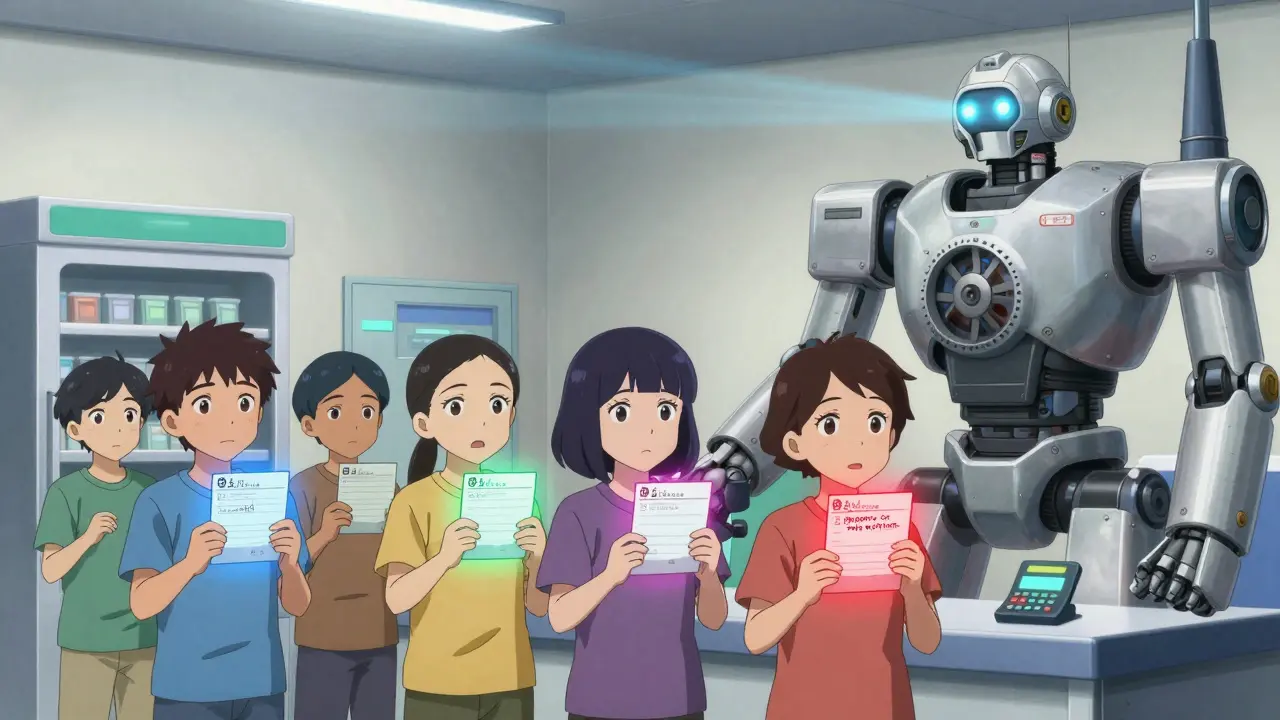
Biosimilars Are a Whole Different Game
Biologic drugs-like insulin, rheumatoid arthritis treatments, and cancer drugs-are complex molecules made from living cells. Their generic versions are called biosimilars. They’re not exact copies like small-molecule generics. Because of that, states treat them differently.
Forty-five states (including D.C.) have special rules for biosimilars. Most require the pharmacist to notify the prescribing doctor within days of the switch. California demands electronic notification within 5 days. Thirty-eight states require patient notification. Only 8 states allow pharmacists to substitute biosimilars without any extra steps.
Despite 32 FDA-approved biosimilars, they make up just 14.3% of eligible prescriptions. Why? Because the rules are too confusing. A pharmacist in Texas might be able to swap a biosimilar without telling anyone. One in Florida might need a new prescription. Patients get stuck in the middle.
What Pharmacists Really Deal With
For pharmacists, this patchwork of laws is a nightmare. One pharmacist on Reddit said they spend 15 to 20 minutes a day just checking rules for multi-state telepharmacy work. A 2023 survey found 78% of pharmacists do the same. Nearly half report making at least one substitution error in the past year.
Independent pharmacies struggle the most. They don’t have the tech or staff to keep up. Chain pharmacies spend an average of $1.2 million per year per state just to stay compliant. That’s why 63% of pharmacists say navigating these rules is one of their top three administrative burdens.
And it’s not just time. In states without liability protection, pharmacists refuse substitutions even when they’re safe. One pharmacist in Connecticut told Pharmacy Times she won’t switch warfarin generics unless the doctor says so-even though the FDA says they’re interchangeable. That’s because she’s afraid of being sued.

Where the System Is Working
Some states have figured it out. California’s electronic notification system for biosimilars cut substitution errors by 32%. The system automatically alerts the doctor, logs the change, and keeps a record. It’s simple, fast, and safe.
States with mandatory substitution and clear liability protection have the best outcomes. Patients pay less. Pharmacists feel safer. Errors drop. The USC Schaeffer Center found that in mandatory states, per capita prescription costs are 5.2% lower. That’s about $55 a year per person.
What’s Changing? And What’s Next?
The system is under pressure. In 2024, the National Association of Boards of Pharmacy launched a project to reduce 51 sets of rules down to just three regional models by 2027. The FDA is pushing for alignment too. Commissioner Robert Califf called state-level fragmentation “the single greatest barrier to biosimilar adoption.”
Nine states passed reforms in 2023-2024 to simplify rules. Texas, Illinois, and Pennsylvania moved to treat biosimilars more like regular generics. But progress is slow. The Congressional Budget Office estimates harmonized rules could save $14.3 billion over ten years. Yet 72% of pharmacy leaders believe federal preemption is needed-meaning the federal government should override state laws entirely.
For now, the system stays broken. And you, the patient, are left to navigate it alone.
What You Need to Do
You don’t need to memorize 51 sets of laws. But you do need to ask questions:
- Ask your pharmacist: “Is this a generic? Can I get it if I want to?”
- If you’re on a critical drug (like blood thinners, seizure meds, or insulin), ask if the generic is FDA-approved as interchangeable.
- Check your prescription label. If the name changed, ask why.
- Know your state’s rules. If your state requires consent, make sure you’re being asked.
The system isn’t designed for you to understand it. But you have the right to know what’s in your medicine-and how much it costs.
Can a pharmacist substitute a brand-name drug without telling me?
Yes, in 20 states and D.C., pharmacists are not required to notify you before substituting a generic drug. In the other 31 states and D.C., they must inform you-either verbally, in writing, or electronically. If you’re unsure, always ask. You have the right to know what medication you’re taking.
Do I have to give consent before getting a generic drug?
Only in 7 states and D.C. do you need to give explicit consent before a substitution. In those places, the pharmacist must ask you to sign a form or verbally agree. In the other 43 states, consent is not required. That doesn’t mean you can’t refuse-you can always say no, even if it’s not legally required.
Why do some states require doctor notification for biosimilars?
Biosimilars are more complex than regular generics. They’re made from living cells, so even small differences can affect how they work in the body. To ensure safety, 45 states require pharmacists to notify the prescribing doctor after a biosimilar substitution. This helps the doctor monitor for side effects or effectiveness changes. California requires electronic notification within 5 days so the doctor can access the record.
Can I ask for a brand-name drug even if a generic is available?
Yes. You can always request the brand-name version. Your pharmacist must honor that request. Some insurance plans may charge you more if you choose the brand, but you still have the right to do so. If your doctor wrote “dispense as written,” that also prevents substitution.
Are generic drugs as safe as brand-name drugs?
Yes. The FDA requires generic drugs to have the same active ingredients, strength, dosage form, and route of administration as the brand-name version. They must also prove they work the same way in the body. The only differences are in inactive ingredients like color or filler, which rarely affect safety. The FDA monitors generics just as closely as brand-name drugs.
Why are biosimilars not used more often?
Despite being approved by the FDA, biosimilars are used in only 14.3% of eligible cases. The main reason is inconsistent state laws. Pharmacists don’t know if they’re allowed to substitute, doctors aren’t notified, and patients are confused. Insurance companies also don’t always cover them. Without clear, uniform rules, adoption stays low-even though biosimilars can save hundreds of dollars per dose.
Sarah Barrett
February 15, 2026 AT 21:01It’s wild how something so fundamental to healthcare-generic substitution-turns into a bureaucratic maze. I never realized that in some states, you could be handed a completely different pill without a whisper. The FDA says they’re identical, but the system treats them like strangers at a party. No introduction, no warning, just a silent swap and a higher copay. It’s not just inconvenient-it’s a betrayal of trust.
And don’t even get me started on biosimilars. These aren’t your grandpa’s aspirin. They’re living, breathing molecules made in labs that cost more than a small country’s GDP. Yet we treat them like they’re soda pop from a vending machine. No wonder patients are confused, pharmacists are exhausted, and doctors are Googling state laws at 2 a.m.
California’s electronic notification system? That’s the gold standard. Simple, automated, human-centered. Why can’t every state just… copy that? We don’t need 51 rulebooks. We need one sane framework.
Also, the fact that 24 states don’t protect pharmacists from lawsuits? That’s not caution. That’s cowardice. Pharmacists are the last line of defense, and we’re making them afraid to do their job. That’s not safety. That’s systemic sabotage.
And yet, somehow, we still expect them to be flawless. The system is broken. Not because people are lazy. Because the rules were written by committee, not by anyone who’s ever held a prescription bottle in their hand.
Erica Banatao Darilag
February 17, 2026 AT 02:13i just reaallly wanted to say thank you for this post. i’ve been on warfarin for 8 years and i had no idea that in some states they can switch my med without telling me. last year i had a weird bruise and i thought it was just me being clumsy but turns out my generic wasnt the same as before and my dr hadnt been told. i cried reading this. thank you for making it clear. i’m going to ask my pharmacist next time. seriously. thank you.
Michael Page
February 18, 2026 AT 15:30The underlying assumption here-that patients should be informed, that pharmacists should be protected, that consistency should be prioritized-is rooted in a naive belief in institutional benevolence. But institutions are not moral agents. They are systems optimized for cost, liability, and inertia. The fact that 51 states have 51 different rules isn’t a failure of policy-it’s a feature of decentralized power. The real question isn’t how to fix the system. It’s why anyone ever thought it could be fixed without federal intervention. The answer, of course, is that no one really cared until the bills started piling up.
Charlotte Dacre
February 19, 2026 AT 08:32Oh wow. So we’ve created a system where the people who are supposed to be keeping us alive are too scared to do their job because the paperwork is more dangerous than the medicine? Brilliant. Just brilliant. We should put this on a t-shirt: ‘I survived the U.S. healthcare system by asking nicely.’
Kapil Verma
February 19, 2026 AT 11:52India has 28 states and over 1000 languages and we still manage to have uniform drug regulations. Why can’t America? You have one government, one currency, one military-and yet you can’t agree on whether a pharmacist can give you a cheaper pill? This is not complexity. This is incompetence. You have the technology, the science, the infrastructure. What you lack is willpower. Stop treating healthcare like a political football. People are dying because of this mess.
Mandeep Singh
February 21, 2026 AT 03:53Let me tell you something no one else will: the entire U.S. pharmacy system is a house of cards built on ignorance and greed. You think biosimilars are hard? Wait until you try to get insulin in Texas versus New York. One state says you need a new prescription. Another says you can swap it like coffee. And the insurance companies? They don’t care-they just want to maximize profits. And pharmacists? They’re stuck in the middle, terrified of lawsuits, forced to memorize 51 rulebooks, and paid minimum wage. This isn’t healthcare. It’s a horror show where the monster is bureaucracy. And guess what? You’re paying for the ticket. You’re paying for the fear. You’re paying for the silence. And you still think you’re getting value? Wake up. This system is designed to keep you confused, compliant, and quiet.
Betty Kirby
February 21, 2026 AT 14:42Let’s be honest: the real reason this is so chaotic is because the pharmaceutical industry lobbies for it. Brand-name companies don’t want generics to be easy to swap-they want you to keep paying $500 for a pill that costs $3 to make. And the states? They’re too busy fighting over Medicaid funding to care. So they create these ridiculous rules-not to protect you, but to create enough confusion that no one notices the price gouging. It’s not incompetence. It’s corporate strategy. And if you think your pharmacist is the villain, you’re missing the whole boardroom.
Josiah Demara
February 22, 2026 AT 20:53Every single argument in this post is a symptom of a deeper disease: American exceptionalism. We don’t have 51 different rules because we’re diverse. We have them because we refuse to centralize anything unless it’s military spending. We’re the only developed country that lets states regulate pharmacy substitution. We’re the only one where a pharmacist needs a law degree to fill a prescription. We’re the only one where patients have to become legal scholars just to get their blood pressure medication. And yet we act surprised when outcomes are worse than in Canada or Germany? This isn’t a policy failure. It’s a cultural failure. We worship individualism so much we’ve destroyed collective safety. And now we’re surprised that people are dying from paperwork.
Kaye Alcaraz
February 23, 2026 AT 15:33