

GI Bleeding Risk Calculator
Your Risk Factors
Every year, millions of people take SSRIs for depression or anxiety, and just as many reach for NSAIDs for back pain, arthritis, or headaches. On their own, these medications are generally safe. But when taken together, they can create a silent, dangerous threat: a much higher chance of life-threatening bleeding in the stomach or intestines. This isn’t a rare side effect. It’s a well-documented, clinically significant interaction that many doctors still miss - and many patients never hear about.
Why This Combination Is So Dangerous
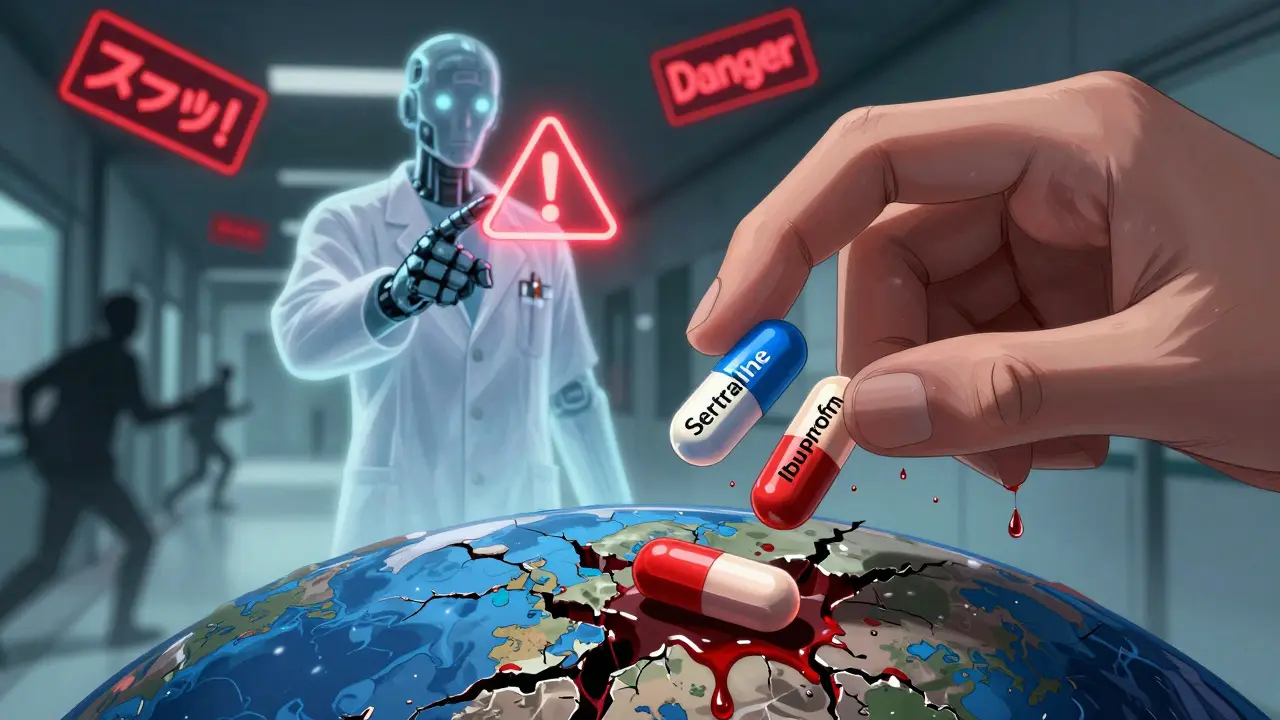
SSRIs like sertraline, fluoxetine, and citalopram work by boosting serotonin in the brain. But serotonin isn’t just a mood chemical. It’s also critical for blood clotting. Platelets, the cells that stop bleeding, rely on serotonin to stick together and seal damaged blood vessels. SSRIs block serotonin from being taken back up into platelets, leaving them sluggish. That means even a small cut in the stomach lining can start bleeding and won’t stop easily. NSAIDs - including ibuprofen, naproxen, and diclofenac - attack pain and inflammation by blocking enzymes called COX-1 and COX-2. But COX-1 does something vital: it helps produce prostaglandins, which protect the stomach lining with mucus and keep blood flowing to the gut. When NSAIDs shut down COX-1, that protective layer thins. The stomach becomes more vulnerable to acid, and tiny ulcers can form. Put them together, and you get a one-two punch: the stomach lining is weakened, and the body’s ability to stop bleeding is impaired. This isn’t just a small increase in risk. Studies show the combination raises the chance of upper GI bleeding by 75% compared to taking either drug alone. That’s not a minor concern - it’s a major safety issue.Who’s at the Highest Risk?
Not everyone who takes both drugs will bleed. But some people are far more vulnerable. The biggest risk factors are:- Age 65 or older
- History of peptic ulcers or GI bleeding
- Taking blood thinners like warfarin or aspirin
- High-dose or long-term NSAID use
- Helicobacter pylori infection (a common stomach bacteria that causes ulcers)
Not All NSAIDs Are Created Equal
If you need pain relief while on an SSRI, not all NSAIDs carry the same danger. Some are worse than others.- High-risk NSAIDs: Naproxen, diclofenac, piroxicam - these strongly block COX-1 and carry the highest bleeding risk.
- Lower-risk NSAID: Ibuprofen - while still risky, it’s the least harmful among traditional NSAIDs when used short-term and at low doses.
- Safest option: Celecoxib - a COX-2 selective NSAID. It doesn’t interfere much with stomach protection. Studies show its bleeding risk is close to that of a placebo when used alone, and much lower than naproxen or diclofenac when combined with SSRIs.

What About SSRIs? Are Some Safer?
Most SSRIs have a similar effect on platelets because they all block serotonin reuptake. But some evidence suggests minor differences. Fluvoxamine and paroxetine may have slightly stronger antiplatelet effects than escitalopram or sertraline. That said, the difference isn’t big enough to rely on - if you’re on any SSRI and taking an NSAID, you’re still at elevated risk. If you’re starting an antidepressant and already take NSAIDs, talk to your doctor about switching to an antidepressant that doesn’t affect platelets. Bupropion (Wellbutrin) is a good alternative. It works on dopamine and norepinephrine, not serotonin, and doesn’t increase bleeding risk. For many people, it’s just as effective as SSRIs for depression and anxiety.The Best Protection: Proton Pump Inhibitors (PPIs)
If you absolutely need both an SSRI and an NSAID, the single most effective way to prevent bleeding is to add a proton pump inhibitor (PPI). Medications like omeprazole, esomeprazole, or pantoprazole reduce stomach acid and help heal and protect the stomach lining. Studies show PPIs reduce the excess bleeding risk from SSRI-NSAID combos by about 70%. That means your risk drops from 75% higher than normal back down to near baseline levels. It’s not perfect, but it’s the best protection we have. Guidelines from the American College of Gastroenterology recommend PPIs for anyone taking both drugs - especially if they’re over 60, have a history of ulcers, or take other blood-thinning meds. A typical dose is omeprazole 20 mg once daily. Many people take it for months or even years without issue. The benefits far outweigh the risks.What You Can Do Right Now
You don’t have to wait for your next appointment to protect yourself. Here’s what to do:- Check your meds. Make a list of everything you’re taking - including over-the-counter painkillers. If you’re on an SSRI and any NSAID, flag it.
- Ask your doctor: "Am I at risk for stomach bleeding from these medications?" Don’t assume they know. A 2021 survey found only 22% of doctors routinely prescribe PPIs for patients on both drugs.
- Ask about alternatives: Can your pain be managed with acetaminophen (Tylenol)? Is bupropion an option instead of your current SSRI?
- Ask about PPIs: If both meds are necessary, request a PPI. Most are available over the counter and safe for long-term use.
- Know the warning signs: Black, tarry stools; vomiting blood or material that looks like coffee grounds; sudden dizziness or weakness; unexplained abdominal pain. These are signs of bleeding. Go to the ER - don’t wait.
Why This Problem Keeps Happening
You’d think this would be common knowledge by now. But it’s not. A 2022 survey of 452 patients found that 68% were never warned about this interaction. Doctors often focus on the mental health benefits of SSRIs or the pain relief from NSAIDs - and forget the gut. Even worse, many patients self-medicate. They take ibuprofen for a sore knee while on sertraline, thinking it’s harmless. They don’t connect the dots until they’re in the hospital with internal bleeding. Health systems are starting to catch on. Mayo Clinic and Cleveland Clinic added automated alerts to their electronic records in 2019. After implementation, GI bleeding hospitalizations dropped by 42% among patients on both drugs. That’s proof that systems can save lives.The Bigger Picture
This isn’t just about individual pills. It’s about how we prescribe. SSRIs are taken by over 34 million Americans. NSAIDs are used daily by 17 million. When nearly 30% of SSRI users also get NSAIDs - as one 2022 audit found - you’re looking at nearly 10 million people at risk. The cost? Over $1.2 billion a year in U.S. healthcare spending just for hospitalizations from these bleeding events. That’s avoidable. With better screening, better alternatives, and better use of PPIs, most of these cases could be prevented. New tools are emerging. AI models now predict individual bleeding risk with over 86% accuracy by analyzing medical records. Companies are testing NSAIDs with built-in PPIs. And guidelines are updating to make PPI co-therapy standard - not optional.Final Takeaway
SSRIs and NSAIDs are both useful. But together, they’re a ticking time bomb for your stomach. You don’t need to stop either one - but you do need to act. If you’re on both, talk to your doctor today. Ask if you need a PPI. Ask if there’s a safer painkiller. Ask if another antidepressant might work better. Don’t wait for a crisis. This risk is real, measurable, and preventable.Can I take ibuprofen with an SSRI?
You can, but it’s not safe without protection. Taking ibuprofen with an SSRI increases your risk of stomach bleeding by 75%. If you must use it, take it at the lowest dose for the shortest time possible - and always add a proton pump inhibitor like omeprazole. Talk to your doctor before combining them.
Is celecoxib safer than other NSAIDs with SSRIs?
Yes. Celecoxib is a COX-2 selective NSAID, meaning it doesn’t significantly interfere with the stomach’s protective lining. Studies show it carries a much lower risk of GI bleeding than naproxen or diclofenac when used with SSRIs. For people who need long-term pain relief and are on an SSRI, celecoxib is often the best NSAID choice - especially when paired with a PPI.
Do all SSRIs increase bleeding risk equally?
Most SSRIs have a similar effect on platelets because they all block serotonin reuptake. Some studies suggest escitalopram and sertraline may have slightly less impact than fluvoxamine or paroxetine, but the difference is small and not reliable enough to choose one over another based on bleeding risk alone. If you’re on any SSRI and an NSAID, assume you’re at elevated risk.
Can I use acetaminophen instead of NSAIDs while on an SSRI?
Yes. Acetaminophen (Tylenol) is the safest pain reliever to use with SSRIs because it doesn’t affect platelets or the stomach lining. It’s effective for mild to moderate pain like headaches, muscle aches, and arthritis discomfort. It won’t help with inflammation like NSAIDs do, but for many people, it’s enough - and it doesn’t raise bleeding risk.
Should I get tested for H. pylori if I’m on both drugs?
If you’re at high risk - over 60, have a history of ulcers, or are on long-term NSAIDs and SSRIs - yes. H. pylori is a common bacteria that causes stomach ulcers and greatly increases bleeding risk. Testing is simple (breath, stool, or blood test), and if positive, treatment with antibiotics can eliminate the infection and reduce your risk by up to 50%. The American College of Gastroenterology now recommends this for high-risk patients before starting dual therapy.
What are the signs of GI bleeding I should watch for?
Watch for: black, sticky, tar-like stools; vomiting blood or material that looks like coffee grounds; sudden dizziness, fainting, or weakness; sharp or persistent abdominal pain; or unexplained fatigue. These are signs of active bleeding. Don’t wait. Go to the emergency room immediately. Early treatment saves lives.
Kinnaird Lynsey
December 19, 2025 AT 10:47So I’ve been on sertraline for 5 years and take ibuprofen every other day for my knees. No idea this was a thing. My doctor never mentioned it. Guess I’m lucky I haven’t bled out yet. Time to ask about PPIs.
Also why does everyone act like celecoxib is some magic bullet? It’s still a drug. And it’s expensive. Not everyone can afford it.
Glen Arreglo
December 20, 2025 AT 01:07Look I get it, the medical system is broken. But this isn’t rocket science. If you’re on an SSRI and popping NSAIDs like candy, you’re asking for trouble. I’ve seen three guys in the ER with GI bleeds in the last year. All of them were on ibuprofen and fluoxetine. No one told them. No one warned them. And now they’re paying the price.
Stop treating meds like they’re vitamins. They’re not. They’re chemicals that interact. And if your doc doesn’t know this, find a new one.
shivam seo
December 20, 2025 AT 08:45Oh wow another fearmongering article from the US medical-industrial complex. You’re telling me people are dying because they take Advil and Zoloft? What’s next, oxygen is dangerous when combined with breathing?
Meanwhile in Australia we just tell people to stop being lazy and use ice packs and stretching. No PPIs needed. No celecoxib. No $200/month prescriptions. Just common sense. You Americans turn every damn thing into a crisis.
benchidelle rivera
December 21, 2025 AT 23:55This is exactly why I stopped prescribing SSRIs without first screening for NSAID use. I’ve had patients come in with melena after being on a 10-year regimen of naproxen and escitalopram. No one ever connected the dots. The data is clear. The guidelines are clear. The failure is systemic.
Every patient on an SSRI should be asked: ‘Are you taking any OTC pain relievers?’ If yes, then PPI co-therapy should be standard. Not optional. Not ‘if you can afford it.’ Standard. And if they’re over 60? Mandatory.
It’s not about scaring people. It’s about preventing preventable death.
Connie Zehner
December 23, 2025 AT 16:37OMG I’m so glad I found this!! I’ve been on Lexapro for 3 years and take Advil for my migraines like, every week 😭 I had black stools last month but I thought it was just my diet?? I’m literally crying rn bc I almost died and no one told me!!
Also I just looked up omeprazole and it’s like $4 at Walmart?? Why didn’t my psychiatrist say anything?? I feel so betrayed 😭😭😭
Can someone tell me if Tylenol is really safe?? I’m scared to take anything now 😭
Vicki Belcher
December 24, 2025 AT 08:29Y’all. I just called my doctor. I’m on sertraline and take ibuprofen for my lower back. She said ‘Oh honey, you need a PPI.’ And she prescribed me omeprazole. No big deal. No drama. Just a quick fix.
So if you’re reading this and you’re on both? Do it. It’s 2025. We have the tools. Don’t wait until you’re vomiting coffee grounds. Just ask. It’s that simple. ❤️
Alex Curran
December 26, 2025 AT 05:33Interesting but incomplete. What about the role of alcohol? Heavy drinkers on SSRIs and NSAIDs have 3x the bleeding risk. And what about the gut microbiome? Some studies show low microbiome diversity increases vulnerability even without H. pylori. And why no mention of aspirin? Even low dose aspirin with SSRIs is a known combo for disaster. Also why assume PPIs are always safe? Long term use links to B12 deficiency and C. diff. Not perfect but better than bleeding out.
Also celecoxib isn't always accessible. Some insurance won't cover it. So what then? Just stop pain meds? That's not a solution.
Lynsey Tyson
December 28, 2025 AT 01:12I’ve been on citalopram for 7 years and take Tylenol for everything. Never even thought about NSAIDs. This post saved me from a nightmare. Thank you.