
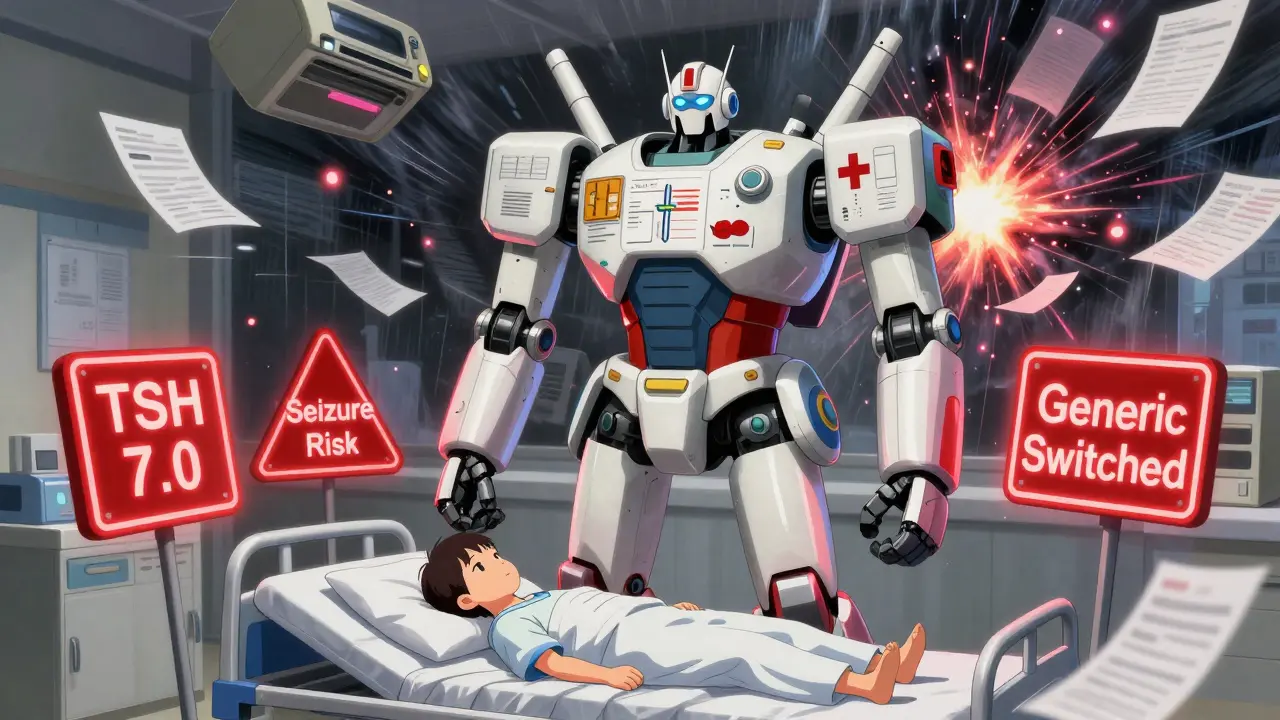
When you take a medication for epilepsy or hypothyroidism, your life depends on consistency. One pill, one dose, one formulation - change that even slightly, and you could face a seizure, a stroke, or worse. Yet for millions of people in the U.S., getting the exact brand-name version of their NTI drug isn’t automatic. Even when generics are available, insurers often force patients and doctors through a maze of paperwork just to keep them on the same medicine they’ve been stable on for years. This isn’t about saving money. It’s about risk - and too often, the system ignores it.
What Are NTI Drugs, and Why Do They Matter?
Narrow Therapeutic Index (NTI) drugs are a small group of medications with a razor-thin line between helping you and harming you. The FDA defines them as drugs where even tiny changes in blood levels - from switching brands, dosing errors, or formulation differences - can lead to treatment failure or serious side effects. Think of it like driving a car with no margin for error: one wrong turn, and you crash.
Common NTI drugs include:
- Levothyroxine - used for hypothyroidism. A 5% change in absorption can throw TSH levels into dangerous territory.
- Phenytoin and Carbamazepine - antiseizure meds. A slight drop in concentration can trigger a seizure.
- Warfarin - a blood thinner. Too much? Bleeding. Too little? Clots.
- Valproate and Phenobarbital - also used for epilepsy and mood disorders.
There are about 37 drugs on this list, according to DrugBank. They make up less than 3% of all specialty drugs, but they account for over 5% of all prior authorization requests. Why? Because insurers know these drugs are high-risk - and they’re scared of liability.
Why Do Insurers Still Require Prior Authorization for NTI Drugs?
You’d think insurers would automatically approve brand-name NTI drugs. After all, the risks are well documented. But many don’t. Instead, they apply the same rules used for regular drugs: if a generic exists, you must try it first. This is called step therapy. For most medications, it works fine. For NTI drugs? It’s dangerous.
Here’s the problem: generic versions of NTI drugs aren’t always interchangeable. The FDA allows generics to vary by up to 20% in bioavailability compared to the brand. That’s fine for antibiotics or statins. For levothyroxine? A 15% drop in absorption could mean your TSH jumps from 2.5 to 7.0 - enough to cause fatigue, weight gain, heart issues, or even heart failure.
Dr. Michael Rea of RxRevu put it bluntly: “Prior authorization for NTI drugs creates dangerous delays for patients who need therapeutic consistency. In epilepsy, even minor formulation changes can trigger seizures.”
Insurers argue they’re protecting against unnecessary spending. But data shows otherwise. A 2023 study in the Journal of Managed Care & Specialty Pharmacy found that 82.4% of NTI prior authorization requests were eventually approved - meaning most denials were just delays. The real cost? Patient harm.
How the System Actually Works - And Why It’s Broken
Getting approved for an NTI drug isn’t simple. Even if your doctor writes “brand necessary,” insurers often require:
- Lab results (TSH, INR, drug levels)
- Proof of prior generic failure
- Weight and height measurements
- Specific diagnosis codes
Some insurers, like Health Net, have updated policies to say NTI brand drugs “do not require prior approval.” But many others still demand paperwork. And even when they don’t require prior authorization, they may place the brand drug on a higher tier - meaning higher copays that patients can’t afford.
Processing times vary wildly. On average, it takes 3.2 business days to get approval. But for NTI drugs? It’s 22% longer than standard requests because of extra documentation. That’s 4-5 days - time many patients don’t have.
One neurologist on Reddit shared that 73% of their levothyroxine brand requests were initially denied - even when patients had TSH levels fluctuating by 300% after switching generics. That’s not insurance oversight. That’s negligence.
State Laws Are Changing - But Slowly
There’s hope. Since 2022, 18 states have passed laws requiring automatic approval if insurers don’t respond within mandated timeframes. California’s AB-1428, effective January 1, 2025, bans prior authorization for NTI drugs if the patient was previously stable on the brand. Other states, like North Carolina and Mississippi, still require forms, faxes, and portals - but even those are moving toward electronic systems.
Electronic prior authorization cuts processing time by 42%. But NTI requests still take longer. Why? Because insurers demand clinical data that’s not always available at the point of care. A single lab result can stall approval for days.
And while Medicaid must respond within 24 hours for urgent cases - and provide a 72-hour emergency supply - commercial insurers have no such rules. The AMA reports that 35 states now require review timelines, but only 15 require 24-hour responses for urgent cases. Most NTI drug cases qualify as urgent - yet they’re often treated as routine.
What Patients and Doctors Are Doing About It
Patients aren’t sitting still. The Patients Rising advocacy group surveyed 1,200 NTI drug users in 2024. The results? 68% had delays longer than 72 hours. 29% reported adverse events - hospital visits, seizures, thyroid crises - directly tied to medication interruptions.
Doctors are fighting back too. The American Academy of Neurology found that unnecessary barriers to brand-name antiepileptic drugs led to preventable seizures in 18.7% of patients in their study of 2,450 people. That’s not a statistic. That’s real people - mothers, teens, veterans - who lost control of their lives because of a form.
Some insurers are starting to listen. One HealthUnlocked user shared that after their first denial caused a grand mal seizure, their insurer automatically approved brand-name Keppra without further paperwork. That’s the right way to do it: respond to harm, not paperwork.

What You Can Do - If You’re on an NTI Drug
If you or someone you care for takes an NTI drug, here’s what to do:
- Know your drug. Is it on the FDA’s NTI list? If yes, demand brand-name consistency.
- Ask your doctor to write “brand necessary” and “do not substitute” on the prescription.
- Check your plan’s formulary. Some insurers list NTI drugs as non-preferred - meaning high copays. Call them.
- Appeal immediately. If denied, file an appeal. You have rights under federal law.
- Use electronic prior auth. Submit requests through your insurer’s portal, not fax. It’s faster.
- Document everything. Keep lab results, TSH levels, seizure logs - and share them.
And if you’re a prescriber? Push back. Use your voice. Insurers are more likely to change policies when doctors speak up in numbers.
The Future: Will NTI Drugs Finally Be Treated Differently?
The tide is turning. The 21st Century Cures Act forced insurers to make prior authorization criteria public - and as a result, 37% more NTI requests are approved on the first try. The Improving Seniors’ Timely Access to Care Act, passed by the House in April 2024, will require Medicare Advantage plans to give real-time decisions - including for NTI drugs.
By 2026, analysts predict 75% of commercial plans will eliminate prior authorization for established NTI drugs. Why? Because the data is clear: the cost of delays - in hospital visits, lost productivity, and human suffering - far outweighs the savings from generic switches.
For now, the system is still broken. But change is coming. And if you’re affected by it, you have more power than you think.
Are generic NTI drugs always unsafe?
Not always - but they’re not always safe either. The FDA allows generics to vary by up to 20% in absorption compared to the brand. For most drugs, that’s fine. For NTI drugs like levothyroxine or phenytoin, even a 10% change can cause serious harm. That’s why many doctors and patients prefer to stick with the brand they know works.
Why do insurers require prior authorization for NTI drugs if they’re high-risk?
Insurers assume that generics are cheaper and equally effective. They don’t always realize that NTI drugs are different. Switching formulations can lead to seizures, strokes, or thyroid crashes - which cost far more than the drug itself. Many insurers are starting to change their policies, but progress is slow because it requires education, data, and pressure from patients and doctors.
Can I switch back to the brand if a generic causes side effects?
Yes - and you should. If you experience new symptoms, lab abnormalities, or worsening symptoms after switching, your doctor can submit a prior authorization request for the brand. Many insurers will approve it after one failure. Keep records of your symptoms and lab results - they’re your strongest evidence.
What states have the best NTI drug protections?
California, New York, and Washington have some of the strongest laws. California’s AB-1428 (2025) bans prior authorization for stable NTI patients. New York requires automatic approval if insurers don’t respond within 72 hours. Washington mandates expedited reviews for NTI drugs. Check your state’s Medicaid website or the AMA’s Prior Authorization State Law Chart for updates.
Is there a list of all NTI drugs?
Yes. The FDA and DrugBank list approximately 37 NTI drugs. Common ones include levothyroxine, phenytoin, carbamazepine, warfarin, valproate, and phenobarbital. Your pharmacist or doctor can confirm if your medication is on this list. The FDA’s 2022 guidance document on generic NTI drugs is the most authoritative source.
Aisling Maguire
March 2, 2026 AT 08:08Okay but like… I just got my levothyroxine switched last month and my TSH went from 2.1 to 6.8 in three weeks. I felt like a zombie. My doctor had to fight the insurer for two weeks just to get me back on the brand. This isn’t bureaucracy-it’s life-or-death stuff. Why do we make people beg for basic stability? 😔
Miranda Anderson
March 2, 2026 AT 12:07I’ve been on carbamazepine for 12 years. Switched generics once because my insurance said ‘it’s the same.’ Three days later I had a partial seizure at work. Didn’t even know it happened until my coworker called 911. The ER doc said, ‘You’re lucky you’re alive.’ Now I have a laminated note taped to my prescription bottle that says ‘DO NOT SUBSTITUTE.’ My doctor signed it. My insurer still tried to deny it last year. They finally gave in after I sent them the ER report. This isn’t about savings. It’s about laziness wrapped in policy.
Gigi Valdez
March 3, 2026 AT 07:45The systemic failure here is not unique to NTI drugs-it reflects a broader misalignment between clinical reality and administrative efficiency. The FDA’s 20% bioavailability allowance was never intended for narrow therapeutic index agents. Yet insurers continue to apply uniform formulary rules, ignoring pharmacokinetic variance. The cost of adverse events far exceeds the marginal savings from generic substitution. A risk-based tiering system, not blanket step therapy, is the evidence-based solution.
Sneha Mahapatra
March 3, 2026 AT 10:28I read this and thought of my aunt in Delhi. She’s on warfarin. Her local pharmacy sometimes runs out of her brand. They give her a generic without telling her. She doesn’t speak English. No one checks her INR. One time she bled internally and ended up in the hospital for three weeks. No one told her the drug was different. No one asked if she’d switched. This isn’t just an American problem. It’s a human one. We treat pills like interchangeable widgets. But bodies aren’t machines.
bill cook
March 4, 2026 AT 10:47So let me get this straight… you’re saying we should just give people whatever brand they want and not care about cost? Who’s gonna pay for it? The government? My taxes? I work two jobs and still can’t afford my own meds. This isn’t about safety-it’s about entitlement. If you can’t afford the brand, maybe you shouldn’t be on it. There’s a reason generics exist.
Byron Duvall
March 5, 2026 AT 12:35They’re lying. All of them. Insurers don’t care about safety-they care about control. This whole NTI thing? It’s a front. The real goal is to force people into Medicaid so they can offload the cost. And don’t get me started on the FDA. They’re in bed with Big Pharma. The ‘20% variance’? That’s a loophole written by lobbyists. They want you dependent. They want you scared. And they want you to think this is normal.
Katherine Farmer
March 6, 2026 AT 10:03It’s rather tiresome how emotionally charged this narrative has become. The data is clear: 82% of prior auth requests are approved. That suggests the system is working, albeit imperfectly. The real issue is not policy-it’s patient education. If individuals understood bioequivalence thresholds, they’d realize most switches are benign. The emotional anecdotes, while compelling, are statistically irrelevant. We must not let anecdotal evidence override evidence-based practice.
Full Scale Webmaster
March 6, 2026 AT 22:48My sister had a grand mal seizure because her insurer forced her off brand phenytoin. She was 24. She lost her job. Her boyfriend left. She’s on SSDI now. The insurer paid $12,000 in ER bills that month. The brand cost $45/month. They saved $300. They destroyed her life. I’ve filed 14 complaints. I’ve called every senator. I’ve emailed the CEO of UnitedHealth. No one answers. No one cares. They see a number. Not a person. Not a soul. Not a human being who used to dance at weddings. Now she sits in a wheelchair because a spreadsheet said ‘switch.’
And now you’re telling me this is about ‘cost savings’? No. It’s about greed. And it’s evil.
Brandie Bradshaw
March 8, 2026 AT 12:40There’s a reason the FDA doesn’t classify all generics as interchangeable for NTI drugs-because they’re not. The 20% variance isn’t a technicality; it’s a gamble with neurological stability. And yet, insurers continue to treat this like a supply-chain logistics problem. They demand lab results, weight logs, diagnosis codes-like we’re filling out a DMV form for a life-saving treatment. Meanwhile, the same insurers have zero accountability when patients end up in ICU because of a form. Where’s the liability? Where’s the reckoning? It’s buried under layers of bureaucracy. And it’s killing people.
Angel Wolfe
March 8, 2026 AT 18:37Sophia Rafiq
March 9, 2026 AT 16:29NTI = high risk. Brand = consistency. Generic = 20% swing. That’s not a difference-it’s a hazard. Insurers treat this like it’s a soda brand switch. It’s not. It’s a neurochemical tightrope. My neurologist says 1 in 4 of his patients on generics have subtherapeutic levels. That’s not a glitch. That’s a pattern. And yeah-electronic prior auth cuts time by 42%. But we still need to remove the barrier entirely. No forms. No delays. Just give them what works. Simple.