

When a panic attack hits, time doesn’t slow down - it vanishes. Your heart pounds like it’s trying to escape your chest. Your breath turns shallow, your hands go numb, and your mind screams that something’s terribly wrong. But here’s the truth: you’re not having a heart attack. You’re not dying. You’re having a panic attack. And there’s a proven way to stop it - not by fighting it, but by working with your body.
Why a Panic Attack Action Plan Works
Panic attacks aren’t random. They’re the result of your body’s fight-or-flight system firing when there’s no real danger. That’s why simply telling yourself to "calm down" doesn’t work. Your nervous system isn’t listening to logic - it’s stuck in survival mode. A panic attack action plan gives you concrete, physical steps to reset that system. It’s not magic. It’s neuroscience.Research from the National Institute of Mental Health shows that about 4.7% of U.S. adults will have a panic attack at some point. But here’s what most people don’t know: those who use a structured action plan reduce their attack frequency by nearly half within eight weeks. That’s not a guess. That’s from a 2021 study in the Journal of Anxiety Disorders.
The best plans combine three things: breathing to calm your body, grounding to pull your mind out of panic, and medication - when needed - to lower the overall intensity. Together, they work like a three-part lock. One alone might help. All three? That’s when real change happens.
Step One: Breathing to Reset Your Nervous System
When you panic, you start breathing too fast. That’s called hyperventilation. It drops carbon dioxide in your blood, which makes your brain think you’re suffocating - even though you’re getting plenty of air. That’s why you feel dizzy, tingling, or like you’re going to pass out.The fix isn’t to breathe harder. It’s to breathe slower. Specifically, you need to extend your exhale. That tells your body it’s safe to relax.
Try the 2-2-6 method:
- Inhale slowly through your nose for 2 seconds.
- Hold your breath for 2 seconds.
- Exhale through your nose for 6 seconds.
- Pause for 1 second before starting again.
Do this for just 90 seconds. That’s all it takes to start lowering your heart rate. This isn’t theoretical. MindWell Leeds tracked users who practiced this daily for eight weeks. Their panic attacks dropped by 47%.
Another effective method is diaphragmatic breathing. Place one hand on your belly. Breathe in through your nose so your hand rises. Breathe out through your mouth slowly, letting your hand fall. You’re not just breathing - you’re activating your vagus nerve, the main highway from your brain to your body’s relaxation response.
Do this every day, even when you’re calm. Build the habit like brushing your teeth. The more you practice, the easier it is to access during a panic attack. People who do 10-20 minutes of daily breathing exercises report fewer attacks and less fear of future ones.
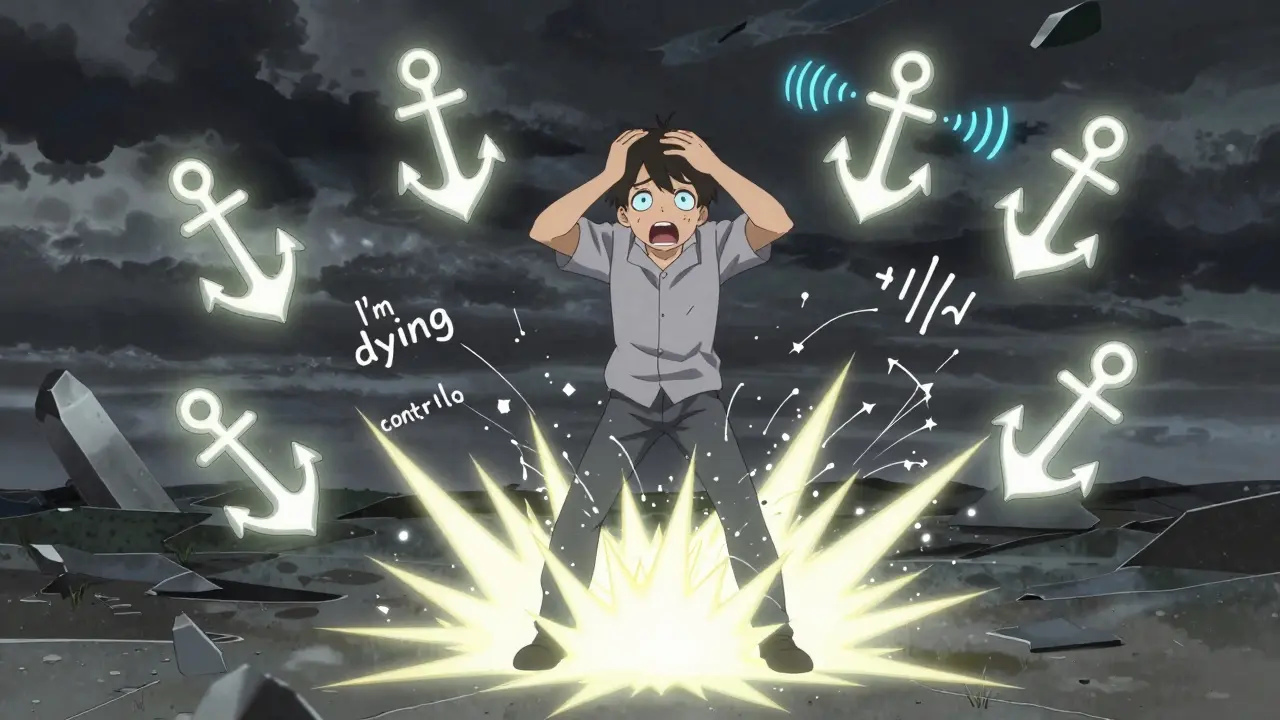
Step Two: Grounding to Bring Your Mind Back to the Present
During a panic attack, your brain gets stuck in a loop of catastrophic thoughts: "I’m losing control," "I’m going to faint," "Something’s seriously wrong." Grounding techniques break that loop by forcing your attention outward - to the real world, not the panic.One of the most powerful tools is simple: say it out loud. Write down phrases like:
- "I’m safe right now."
- "This is panic. It can’t hurt me."
- "This feeling will pass."
Keep them on your phone. Print them on a card. Record them in your voice. When panic hits, play the recording. Hearing your own voice say "you’re okay" is surprisingly calming.
Another method is sensory grounding. Close your eyes. That cuts sensory overload and reduces panic intensity by 32% within 90 seconds, according to the Anxiety and Depression Association of America. Then, name five things you can see, four you can touch, three you can hear, two you can smell, and one you can taste. It sounds silly - until you’re in the middle of an attack and this is the only thing that pulls you back.
Or try distraction. Solve a math problem in your head. Recite the lyrics to a song you know by heart. Play a game on your phone. The goal isn’t to think about something happy - it’s to think about anything that isn’t panic. McGill University found that people who used distraction during attacks reduced their episode length by an average of 8 minutes.
And don’t underestimate the power of touch. Hold an ice cube. Press your feet firmly into the floor. Grip a stress ball. Physical sensation anchors you in the now.
Step Three: Medication - When and How to Use It
Medication isn’t a crutch. It’s a tool - and sometimes, it’s the bridge that lets you learn the other skills.There are two main types used for panic attacks:
- SSRIs (like sertraline or paroxetine): These are antidepressants that also treat anxiety. They take 6-12 weeks to work fully, but once they do, they reduce panic attacks by 60-70%. They’re meant for daily use, especially if you’re having more than two attacks a week.
- Benzodiazepines (like alprazolam or clonazepam): These work fast - within 15-30 minutes. They’re used only during acute attacks, not every day. They’re powerful, but risky. The FDA says 23% of daily users develop tolerance in under six weeks. That’s why doctors only prescribe them short-term or as needed.
Here’s what the data shows: people who combine medication with breathing and grounding have a 68% chance of long-term recovery. Those who use medication alone? Only 42%.
Side effects? Yes. SSRIs can cause nausea or trouble sleeping at first - but 79% of users stick with them because the benefits outweigh the early discomfort. Benzodiazepines? Many stop using them within three months because they fear dependence. That’s smart. They’re not for long-term use.
Medication should never replace practice. It should support it. Think of it like a cast for a broken arm - it holds things steady while you heal. Once you’ve built your breathing and grounding skills, you can often reduce or stop medication - under your doctor’s guidance.
How to Build Your Own Action Plan
Start small. Pick one breathing technique. Practice it for five minutes a day. Add one grounding phrase. Write it on your bathroom mirror. When you feel your first signs of panic - a racing heart, tight chest - pause. Don’t run. Don’t fight. Do your breathing.Keep a simple log: date, time, trigger (if you know it), what you did, how you felt after. After 10-15 entries, patterns emerge. Maybe you panic after caffeine. Maybe it’s before meetings. Maybe nothing triggers it - and that’s okay too. The goal isn’t to find the perfect trigger. It’s to know what works for you.
Use tools. The "Panic Relief" app from UC San Francisco has guided breathing and grounding exercises. It’s rated 4.3 out of 5 by over 1,800 users. The Anxiety and Depression Association of America offers free webinars - 42% of participants called them "highly effective."
And if you’re not sure where to start, ask your doctor for a referral to a therapist trained in cognitive behavioral therapy (CBT). That’s the gold standard. The American Psychological Association gives CBT-based panic plans their highest recommendation - an "A" rating.

What Doesn’t Work (And Why)
Avoidance doesn’t help. If you stop going to stores, driving, or being around people because you fear panic, your brain learns that those places are dangerous. That makes attacks more likely.Ignoring it doesn’t work either. "Just tough it out" leads to more fear - fear of the fear itself. That’s what turns occasional attacks into panic disorder.
And relying only on medication without practicing skills? That’s like taking painkillers for a broken leg but never going to physical therapy. The pain might go away for a while - but the weakness stays.
Real People, Real Results
One Reddit user, after months of panic attacks, started the 2-2-6 breathing technique every morning. Within three weeks, she noticed she could catch the early signs - a flutter in her chest - and stop the attack before it took over. She didn’t eliminate panic. She learned to respond to it.A man in Ohio kept a rubber band on his wrist. When panic hit, he snapped it and said, "Stop." It was a physical cue to interrupt his spiral. He didn’t need to say it out loud. The snap alone was enough.
These aren’t lucky breaks. They’re results of consistent, simple actions.
What to Do Next
You don’t need to fix everything today. Start with one thing:- Download a breathing app or set a daily alarm for 5 minutes of slow breathing.
- Write down one grounding phrase and put it where you’ll see it every day.
- Talk to your doctor about whether medication could help you get to a point where you can practice without being overwhelmed.
Panic attacks don’t define you. Your response to them does. And you have more control than you think.
Can you have a panic attack without knowing it?
Yes. Some people mistake panic attacks for heart problems, vertigo, or even asthma. Symptoms like chest tightness, dizziness, or tingling can feel physical - not emotional. If you’ve had unexplained episodes of these symptoms, especially if they come on suddenly and peak within minutes, it could be panic. Tracking them in a journal helps clarify the pattern.
How long do panic attacks last?
Most panic attacks peak within 10 minutes and last between 5 and 20 minutes. Rarely do they go over 30 minutes. But the fear of the next one can linger for hours. That’s why action plans focus on reducing the fear of panic - not just the attack itself.
Can breathing techniques make panic worse?
Only if done incorrectly. Breathing too fast or too deeply during an attack can trigger hyperventilation. That’s why the focus is on slow, controlled exhales - not big, deep breaths. The 2-2-6 or 4-7-8 methods are designed to avoid this. If you feel lightheaded, stop and breathe normally for a minute before trying again.
Is it safe to use benzodiazepines for panic attacks?
They’re safe for occasional, short-term use under medical supervision. But daily use leads to tolerance and dependence in about 23% of users within six weeks. They’re meant to be a rescue tool - like a fire extinguisher - not something you keep turned on. Always follow your doctor’s instructions and never mix them with alcohol or sleep aids.
What if breathing and grounding don’t work for me?
They work for most people - but only if practiced regularly, not just during attacks. If you’re still struggling after 6-8 weeks of daily practice, consider working with a CBT therapist. Sometimes, underlying trauma or thought patterns need professional help to unravel. That doesn’t mean you’re failing - it means you’re ready for the next step.
Can panic attacks go away forever?
Yes. Studies show that 70-80% of people who stick with a CBT-based action plan stop having panic attacks within a year. It’s not about never feeling anxious - it’s about no longer being controlled by it. You learn to ride the wave instead of drowning in it.
There’s no quick fix. But there is a path - and it’s built one breath, one grounding thought, one small choice at a time.
Marian Gilan
January 27, 2026 AT 17:32Conor Murphy
January 28, 2026 AT 06:56Conor Flannelly
January 29, 2026 AT 15:04Patrick Merrell
January 29, 2026 AT 18:13Dan Nichols
January 29, 2026 AT 20:08Renia Pyles
January 30, 2026 AT 14:34Rakesh Kakkad
January 30, 2026 AT 15:57Shweta Deshpande
January 31, 2026 AT 12:43Robin Van Emous
February 1, 2026 AT 07:08Angie Thompson
February 1, 2026 AT 12:00rasna saha
February 3, 2026 AT 05:47Kipper Pickens
February 4, 2026 AT 03:08Mohammed Rizvi
February 5, 2026 AT 07:28eric fert
February 6, 2026 AT 08:42Shawn Raja
February 7, 2026 AT 16:19