
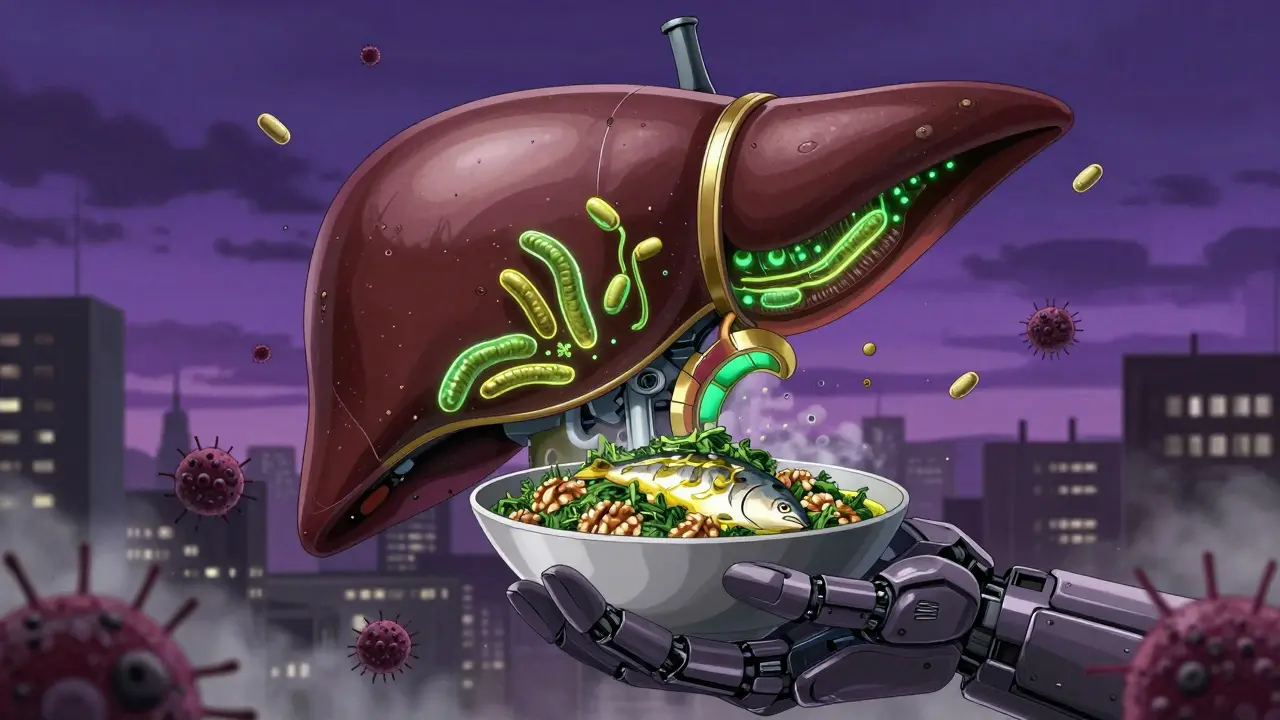
Nonalcoholic fatty liver disease (NAFLD), now more accurately called metabolic dysfunction-associated steatotic liver disease (MASLD), affects about one in three adults worldwide. It’s not caused by drinking alcohol-it’s caused by how you eat, how much you weigh, and what’s happening in your gut. The liver starts storing too much fat, and without change, it can lead to inflammation, scarring, and even liver failure. But here’s the good news: the fix isn’t a pill. It’s food. It’s weight loss. And it’s your gut.
The Gut-Liver Connection You Can’t Ignore
Your gut and liver are connected by a direct pipeline-the portal vein. Every time you eat, what happens in your intestines doesn’t stay there. Bacteria in your gut break down food, produce chemicals, and sometimes leak toxins into your bloodstream. In people with NAFLD, this system goes wrong. The gut lining becomes more porous, letting harmful substances like lipopolysaccharides (LPS) slip into the liver. Studies show LPS levels are 2.3 times higher in NAFLD patients than in healthy people. That triggers inflammation, which turns simple fat buildup into steatohepatitis (NASH).At the same time, the good bacteria in your gut are disappearing. People with NAFLD have less microbial diversity-fewer types of bacteria overall. Their levels of beneficial short-chain fatty acids (SCFAs), especially butyrate, drop by nearly 60%. Butyrate isn’t just fuel for your gut cells-it helps keep your liver from storing fat. Lower butyrate means worse fat buildup.
Some bacteria are overgrown in NAFLD: Lachnospiraceae, Barnesiella, and Proteobacteria. Others, like Bacteroides vulgatus, are missing. This imbalance isn’t just a side effect-it’s part of the disease. The gut doesn’t just react to liver problems; it helps cause them.
Diet Is the First Line of Defense
The American Association for the Study of Liver Diseases says the single most effective treatment for NAFLD is losing weight. But weight loss doesn’t happen in a vacuum. What you eat changes your gut bacteria-and that changes your liver.The Mediterranean diet isn’t just trendy. It’s backed by hard data. In one study, NAFLD patients who ate a Mediterranean diet with 30 grams of walnuts daily for six months cut liver fat by 32%. Why? Walnuts are packed with fiber and polyunsaturated fats. Fiber feeds good bacteria. Polyunsaturated fats reduce liver inflammation. Olive oil, leafy greens, nuts, fish, and legumes make up the core. Avoid processed foods, sugary drinks, and white bread. These spike blood sugar and feed the bad bacteria that worsen liver fat.
Fructose is a silent killer in NAFLD. It’s not just in soda-it’s in fruit juices, granola bars, and even ketchup. Limit fructose to under 25 grams a day. That’s about one apple or half a cup of grapes. More than that, and your liver turns it straight into fat.
Calorie reduction matters, but how you do it matters more. A 500-750 calorie daily deficit leads to safe, steady weight loss-about half to one kilogram per week. Crash diets don’t work. They stress your body, raise cortisol, and make your liver hold onto fat. Slow and steady wins the race.
Weight Loss That Actually Reverses Liver Damage
Losing just 5% of your body weight improves fat buildup in 81% of people with NAFLD. Lose 10%, and you have a 45% chance of reversing NASH-the more dangerous stage. These aren’t theoretical numbers. They come from a 2023 meta-analysis of over 10,000 patients.But here’s the catch: most people who lose weight on their own gain it back. Structured programs that combine diet, exercise, and behavioral support have a 68% success rate at keeping weight off after two years. Self-directed attempts? Only 29%.
Exercise alone helps-reducing liver enzymes by 15 units on average. But when you add diet, that number jumps to 28. You don’t need to run marathons. 150 minutes a week of brisk walking, cycling, or swimming is enough. Strength training twice a week helps too-it improves insulin sensitivity, which directly reduces liver fat.
Probiotics and Prebiotics: Helpful, But Not Magic
Probiotics aren’t a cure, but they’re a powerful tool. A double-blind study gave 100 NAFLD patients a daily mix of Lactobacillus rhamnosus GG, Bifidobacterium longum, and Streptococcus thermophilus for six months. Results? Liver fat dropped by 23%. ALT (a liver enzyme) fell by 31%. Digestion improved. Bloating went down.But not all probiotics are equal. You need at least 10^9 to 10^10 colony-forming units (CFU) per day. Single-strain supplements? Usually not enough. Look for multi-strain formulas with documented results in NAFLD. Lactobacillus reuteri NCIMB 30242 is one strain that helps regulate bile acids-key players in fat metabolism.
Prebiotics feed your good bacteria. Inulin and fructo-oligosaccharides (FOS) are the most studied. Taking 10 grams of inulin daily for 12 weeks boosted butyrate levels by 47% and lowered liver stiffness by 15%. That’s a sign of less scarring.
But here’s the reality: probiotics aren’t standard care. The European Association for the Study of the Liver gives them a weak recommendation. Why? Results vary. Some people respond. Others don’t. They’re an add-on-not a replacement-for diet and weight loss.
What Doesn’t Work (And Why)
Fecal microbiota transplantation (FMT)-transferring gut bacteria from a healthy donor-is being tested. Early results show minor improvements in liver enzymes, but no change in liver tissue. It’s still experimental. Don’t waste money on unregulated FMT clinics.Intermittent fasting, like 5:2, is popular on Reddit. Many users report feeling less bloated and more energetic. But there’s no solid evidence yet that it reverses liver fat better than daily calorie control. It might help some people stick to a lower-calorie diet, but it’s not superior. If you can’t do it without feeling exhausted or obsessed with food, skip it.
Detox teas, liver cleanses, and herbal supplements? No proof they help. Some, like green tea extract in high doses, can even harm the liver. Stick to food-first approaches.

Barriers and Real-Life Challenges
The biggest problem isn’t knowing what to do. It’s doing it. A 2023 survey found that 41% of people with NAFLD struggle with dietary adherence. Social events, cravings, and stress are the top reasons people quit.Cost is another hurdle. A healthy diet with fresh produce, nuts, fish, and whole grains can cost $150-$200 more per week than a standard diet of processed foods. Probiotics run $40-$60 a month. Insurance rarely covers them in the U.S.-only 12% of patients get help.
But here’s the flip side: the cost of ignoring NAFLD is far higher. Liver transplants, hospitalizations, and cancer treatments cost tens of thousands. Preventing progression saves money-and life.
Successful programs combine education with support. The European NAFLD Registry found that when patients got clear guidance on gut health and regular check-ins, 56% stuck with the program after six months. Without support? Only 32%.
What to Do Right Now
You don’t need to overhaul your life overnight. Start with these three steps:- Swap one processed food for a whole food every day. Replace soda with sparkling water. Swap white rice for brown. Add a handful of spinach to your eggs.
- Walk 30 minutes a day, five days a week. Don’t count steps. Just move.
- If you’re taking a probiotic, make sure it has at least 10 billion CFU and includes Lactobacillus and Bifidobacterium strains. Take it daily for at least 12 weeks.
Track your progress. Weigh yourself weekly. Note how you feel-energy, bloating, sleep. Small wins add up.
NAFLD isn’t your fault. But reversing it? That’s in your hands. Your gut is listening. Your liver is waiting. What you eat today shapes your liver tomorrow.
Can you reverse NAFLD without losing weight?
No. Weight loss is the only proven way to reverse fatty liver disease. Even small losses-5% of body weight-can reduce liver fat by over 80%. Without losing weight, dietary changes and probiotics may help a little, but they won’t fix the root problem: excess fat in the liver. Think of it like this: you can clean the surface of a greasy pan, but unless you remove the grease, it will come back.
Are probiotics safe for NAFLD patients?
Yes, for most people. Multi-strain probiotics with Lactobacillus and Bifidobacterium are well-tolerated. Some report mild bloating or gas at first, but that usually fades in a week or two. Avoid probiotics if you have a weakened immune system, a central line, or severe illness. Always talk to your doctor before starting any supplement, especially if you’re on other medications.
Is the Mediterranean diet the best diet for NAFLD?
It’s the most studied and most effective. It’s rich in fiber, healthy fats, and antioxidants-all of which reduce liver inflammation and support good gut bacteria. Other diets like low-carb or keto may help with weight loss, but they often lack fiber and can worsen gut diversity. The Mediterranean diet works because it supports both your liver and your gut at the same time.
How long does it take to see results from diet changes?
You might feel better in 2-4 weeks-less bloating, more energy. Liver enzyme levels (like ALT) can drop in 8-12 weeks. But actual fat reduction in the liver takes longer-usually 3 to 6 months of consistent change. Don’t expect overnight results. This is a marathon, not a sprint.
Should I get my gut microbiome tested?
Not yet. While companies offer stool tests claiming to guide your diet for NAFLD, there’s no standard way to interpret the results. The science isn’t advanced enough to say which bacteria you’re missing or what to do about it. Focus on proven strategies: eat more fiber, lose weight, avoid sugar. Save the expensive tests for when they’re backed by clear clinical guidelines.
Cassie Widders
January 11, 2026 AT 19:34Been following this for months. Swapped soda for sparkling water and added spinach to my eggs. Felt less bloated in two weeks. No magic, just consistency.
Rinky Tandon
January 13, 2026 AT 04:59Let me break this down for you like you're five: your gut is a bacterial warzone. NAFLD isn't just fat-it's endotoxin-driven systemic inflammation fueled by LPS leaks from dysbiosis. Butyrate deficiency? That's your gut lining crumbling. Probiotics need at least 10^10 CFU multi-strain, or you're wasting money. And no, kale smoothies won't fix it if you're still eating fructose-laden 'healthy' bars. This isn't wellness influencer content-it's metabolic pathology.
Ben Kono
January 15, 2026 AT 00:14People keep saying Mediterranean diet but no one talks about how expensive it is. Fresh fish nuts olive oil it adds up fast. I got a job at a grocery store and I see the prices every day. Most folks can't afford this. They just eat what's cheap and easy and get blamed for their disease
Monica Puglia
January 16, 2026 AT 08:37This is so helpful 💙 I started walking 30 min a day last week and already my energy is better. No need to run marathons. Just move. Also switched to brown rice and cut out juice. Small steps 👏
Alex Fortwengler
January 17, 2026 AT 21:18Big Pharma doesn't want you to know this because pills make more money. They push statins and liver meds while ignoring the real cause-your gut. The FDA knows probiotics work but won't approve them as treatment because they can't patent bacteria. You're being lied to. Read the 2023 meta-analysis again. They're hiding the truth
jordan shiyangeni
January 18, 2026 AT 09:55It's not just about weight loss-it's about the moral failure of allowing processed foods to become the default. The industrial food complex has weaponized fructose, refined carbs, and seed oils to create a population of metabolically broken individuals. Your liver isn't failing you-it's screaming for justice. You're not lazy; you're poisoned by a system designed to profit from your disease. This isn't health advice-it's a call to revolutionize your relationship with food, or accept the consequences of corporate negligence.
Eileen Reilly
January 18, 2026 AT 21:36So probiotics are kinda a thing but not really? I bought this $50 bottle with 50 billion CFU and I swear I feel different but my doc said it’s placebo. Also I hate the word ‘butyrate’ it sounds like a brand of yoga mat
Craig Wright
January 19, 2026 AT 00:56As a British citizen, I find it frustrating that American health advice ignores our own NHS guidelines. We've had structured NAFLD programs for years with dietitians and group support. The U.S. system is broken-people are left to fend for themselves while corporations profit. This article is accurate, but it's a luxury to have access to this information. Most here can't afford the food, let alone the time to cook it.
Lelia Battle
January 21, 2026 AT 00:51There’s a quiet dignity in the way the body responds to gentle change. Not punishment, not deprivation-but restoration. The liver doesn’t hate you. It’s waiting for you to stop feeding it poison and start feeding it peace. The gut doesn’t need fixing-it needs listening. What if the answer isn’t more intervention, but less interference? Less noise. More stillness. More whole food. More time. Not because it’s trendy, but because it’s true.
Abner San Diego
January 22, 2026 AT 00:42Why are we still talking about diet when the real issue is insulin resistance caused by corporate sugar lobbying? The USDA and FDA are in bed with Big Food. You think this is about health? It's about profit. I've seen the internal memos. They knew about fructose toxicity in the 80s. They buried it. Your liver isn't broken-it's been betrayed.
Amanda Eichstaedt
January 23, 2026 AT 04:24Just wanted to say thank you for writing this. I was diagnosed last year and felt alone. I started walking after dinner and swapped one snack a day for nuts. My ALT dropped 40 points in 3 months. I didn’t lose 10% yet but I feel like I’m finally fighting back. You’re right-it’s a marathon. And I’m not quitting.