

Why Medicaid Spending on Generic Drugs Still Costs Billions
Even though generic drugs make up nearly 85% of all Medicaid prescriptions, they only account for about 16% of total drug spending. That sounds like a win-until you realize Medicaid spent over $57 billion on prescriptions in 2023. The truth is, some generic drugs have gotten wildly expensive, and states are scrambling to fix it.
Take a common antibiotic like doxycycline. A few years ago, a 30-day supply cost under $5. Today, in some states, it’s priced at $80 or more-no new ingredients, no clinical upgrades, just a price spike. That’s not an outlier. In 2023, 23 states reported shortages of critical generic medications, with some drugs unavailable for over four months. These aren’t rare cases. They’re systemic.
The federal Medicaid Drug Rebate Program (MDRP) was designed to keep prices down. Under this program, drugmakers must give states a rebate of at least 13% of the average price they charge pharmacies. But here’s the catch: that 13% doesn’t move much when a generic drug’s list price jumps from $10 to $100. The rebate goes from $1.30 to $13. The state still pays $87 out of pocket.
How States Are Fighting Back: Maximum Allowable Cost Lists
Forty-two states now use Maximum Allowable Cost (MAC) lists to cap what they’ll pay for generic drugs. Think of it like a price ceiling. If a pharmacy tries to bill Medicaid for a generic drug at $50, but the state’s MAC is $12, the pharmacy gets paid $12-or nothing if they don’t adjust their price.
Thirty-one states update their MAC lists quarterly or more often. But here’s the problem: generic prices swing fast. A drug might drop from $40 to $8 overnight after a new manufacturer enters the market. If the state updates its list only once a month, pharmacies get stuck. Many independent pharmacies report delayed payments or denied claims because their system billed the old price. A 2024 survey found 74% of small pharmacies had been hit by MAC list mismatches.
Some states are responding by updating MAC lists weekly. Others are tying them to real-time data from wholesale distributors. But even that’s not perfect. Some manufacturers game the system by selling to distributors at low prices, then raising the price to pharmacies. States are now trying to track actual acquisition costs, not just wholesale prices.
Generic Substitution: The Silent Workhorse of Cost Control
Forty-nine states require pharmacists to substitute a generic version when it’s available-unless the doctor says no. This isn’t new. But it’s powerful. In states like New York and California, this rule alone saves hundreds of millions a year.
What’s changing is how states handle therapeutic substitution. Some now allow pharmacists to switch between different generics in the same drug class if one is cheaper. For example, if a patient is on a $15 generic blood pressure pill and a $7 version is just as effective, the pharmacist can swap it without calling the doctor. That’s called therapeutic interchange.
Twenty-eight states use preferred drug lists that include these kinds of swaps. It’s not just about cost-it’s about keeping patients on treatment. If a drug is too expensive, patients skip doses or stop entirely. States are learning that saving $10 on a pill isn’t worth it if the patient ends up in the ER six months later.
Price Gouging Laws: Targeting Unfair Generic Hikes
States can’t control the free market, but they can draw a line. Maryland was the first to pass a law in 2020 making it illegal to raise prices on generic drugs without a valid reason-like increased production costs or new safety data. If a company hikes the price of a 50-year-old generic by 200% overnight, the state can fine them.
Since then, five more states-California, Colorado, Nevada, Vermont, and Washington-have followed suit. The laws are narrow: they only apply to drugs with no competition, or where supply is limited. They don’t touch drugs with multiple manufacturers. That’s intentional. Too broad, and manufacturers might quit the market entirely.
But enforcement is tricky. How do you prove a price hike is “unjustified”? States now require manufacturers to report pricing changes and justify them in writing. If a company can’t explain why a $0.10 pill suddenly costs $2, they’re on the hook.
Pharmacy Benefit Managers: The Middlemen States Are Trying to Tame
Most states don’t pay pharmacies directly. They hire Pharmacy Benefit Managers (PBMs)-companies like OptumRx and Magellan-to handle claims, negotiate prices, and manage formularies. But PBMs don’t always pass savings along.
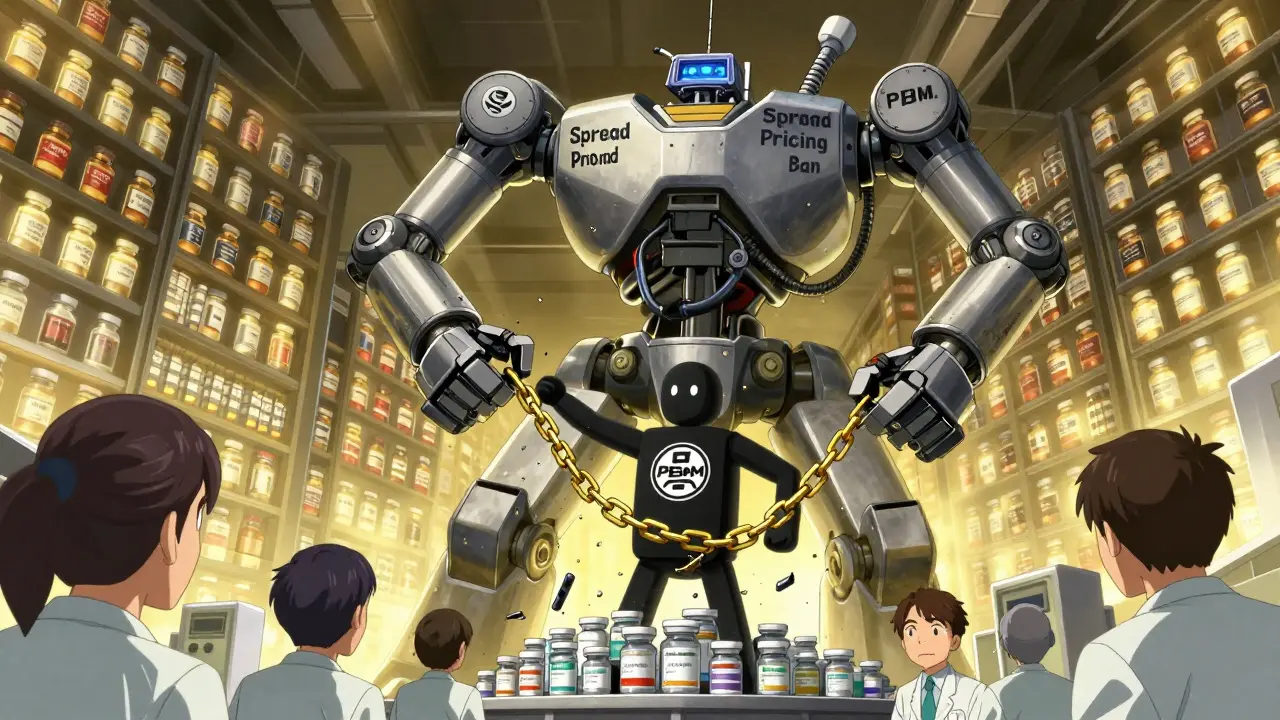
Here’s how it works: a PBM might negotiate a $10 price for a generic drug from a manufacturer. But they tell the pharmacy they’ll pay $15. Then they charge Medicaid $18. The $8 difference? That’s the PBM’s profit. It’s called spread pricing.
Twenty-seven states passed new rules in 2024 requiring PBMs to disclose what they actually pay for drugs. Nineteen now require them to pass the full discount to the state. Maryland and New York even banned spread pricing entirely for Medicaid. The result? Some states saw their generic drug costs drop by 8-12% in the first year.
But PBMs fight back. They’ve sued several states, claiming these rules violate federal law. Courts are still deciding. Meanwhile, states are turning to direct contracting-bypassing PBMs altogether-to buy generics in bulk.

Supply Chain Risks and the New Stockpile Strategy
When a single factory in India or China shuts down, it can trigger a nationwide shortage of a generic drug. Three companies now control 65% of the market for injectable generics. If one of them has a quality issue, hundreds of thousands of patients are at risk.
Twelve states introduced legislation in 2024 to build strategic stockpiles of critical generics. Oregon and Texas are leading the way. Oregon now keeps a six-month reserve of life-saving antibiotics and seizure medications. Texas has created a state-run warehouse for insulin and heart drugs.
It’s expensive. But cheaper than emergency hospitalizations. A single shortage of a common blood thinner can lead to strokes. The cost of one stroke? Over $100,000. Stockpiling a few thousand doses of the drug costs less than $10,000.
By 2026, the National Academy for State Health Policy predicts 22 states will have formal stockpile programs. It’s not just about price anymore. It’s about survival.
The Big Trade-Off: Saving Money vs. Keeping Drugs Available
Every policy has a downside. MAC lists can block access if they’re too low. Price gouging laws can scare manufacturers away. PBMs might stop serving states that demand too much transparency.
The Congressional Budget Office warns that overly aggressive price controls could reduce generic drug availability by 2-5%. That’s not hypothetical. In 2023, one major manufacturer stopped making a generic antidepressant after a state lowered its reimbursement rate below production cost. Patients had to switch to a brand-name drug that cost 20 times more.
States are learning to balance this. They’re not trying to slash prices to the bone. They’re trying to stop abuse. They’re targeting drugs with no competition, sudden price spikes, and monopolistic markets.
It’s working. In states with strong MAC lists and anti-gouging laws, generic drug spending growth slowed to 1.2% in 2024-down from 7.8% in 2021. That’s $1.4 billion saved in just three years.
What’s Next? GLP-1 Drugs, Cell Therapies, and the Future of Medicaid
Generics are still the foundation. But the next big cost spike isn’t coming from old pills. It’s coming from new ones.
GLP-1 medications for weight loss-like Wegovy and Ozempic-now cost $12,000 a year. Thirteen state Medicaid programs cover them, but only with strict rules: patients must have diabetes or severe obesity, and they must try cheaper options first.
And soon, gene therapies could hit Medicaid. A single treatment for a rare disease might cost $2 million. States aren’t ready. But they’re preparing. The Centers for Medicare & Medicaid Services is testing a new model for high-cost therapies that could apply to generics too-by tying payments to long-term outcomes.
For now, the focus stays on generics. Because if you fix the foundation, you don’t need to fix everything else.
How do Medicaid generic drug policies differ from Medicare’s?
Medicare doesn’t have state-level control over drug pricing. It relies on federal negotiations and formularies. Medicaid, by contrast, lets each state set its own rules-like MAC lists, preferred drug lists, and anti-gouging laws. That’s why Medicaid spending on generics varies widely by state, while Medicare’s is more uniform.
Can states force pharmacies to use cheaper generics?
Yes. Forty-nine states require pharmacists to substitute a generic drug when it’s available and the prescriber hasn’t blocked it. Some states go further and allow pharmacists to switch between different generics in the same class if one is significantly cheaper-without needing a new prescription.
Why do generic drug prices go up even when there’s no shortage?
When competition drops-say, from five manufacturers to two or one-the remaining companies can raise prices. Some manufacturers buy out competitors to reduce competition. Others delay entering the market, waiting for others to absorb the cost of FDA approval. These market dynamics, not production costs, are why prices spike even without shortages.
Do MAC lists hurt small pharmacies?
They can. If a MAC list isn’t updated quickly, a pharmacy might bill Medicaid for a drug at $15, but the state only pays $8. The pharmacy loses money on that claim. Many small pharmacies report delayed payments or claim denials because their systems can’t keep up with fast-changing MAC prices. States are improving this by updating lists weekly and giving pharmacies real-time price alerts.
What’s the biggest mistake states make with generic drug policies?
Setting prices too low without understanding the real cost to produce the drug. If a state caps reimbursement below what it costs to make or distribute a generic, manufacturers stop making it. That leads to shortages. The goal isn’t to pay the least-it’s to pay fairly and keep drugs available.
Are state generic drug policies legal?
Most are, but they’re being challenged in court. Pharmaceutical companies argue that state price controls violate federal law by interfering with interstate commerce. So far, courts have mostly upheld state laws-especially when they target price gouging or require transparency. But legal uncertainty remains, and some states have paused new policies while lawsuits play out.
Anthony Massirman
February 1, 2026 AT 15:13Brittany Marioni
February 2, 2026 AT 09:06George Firican
February 3, 2026 AT 19:43Solomon Ahonsi
February 5, 2026 AT 18:47Marc Durocher
February 7, 2026 AT 18:23Chinmoy Kumar
February 9, 2026 AT 18:00phara don
February 11, 2026 AT 06:24larry keenan
February 12, 2026 AT 14:31Matt W
February 13, 2026 AT 18:59Nick Flake
February 15, 2026 AT 14:36