
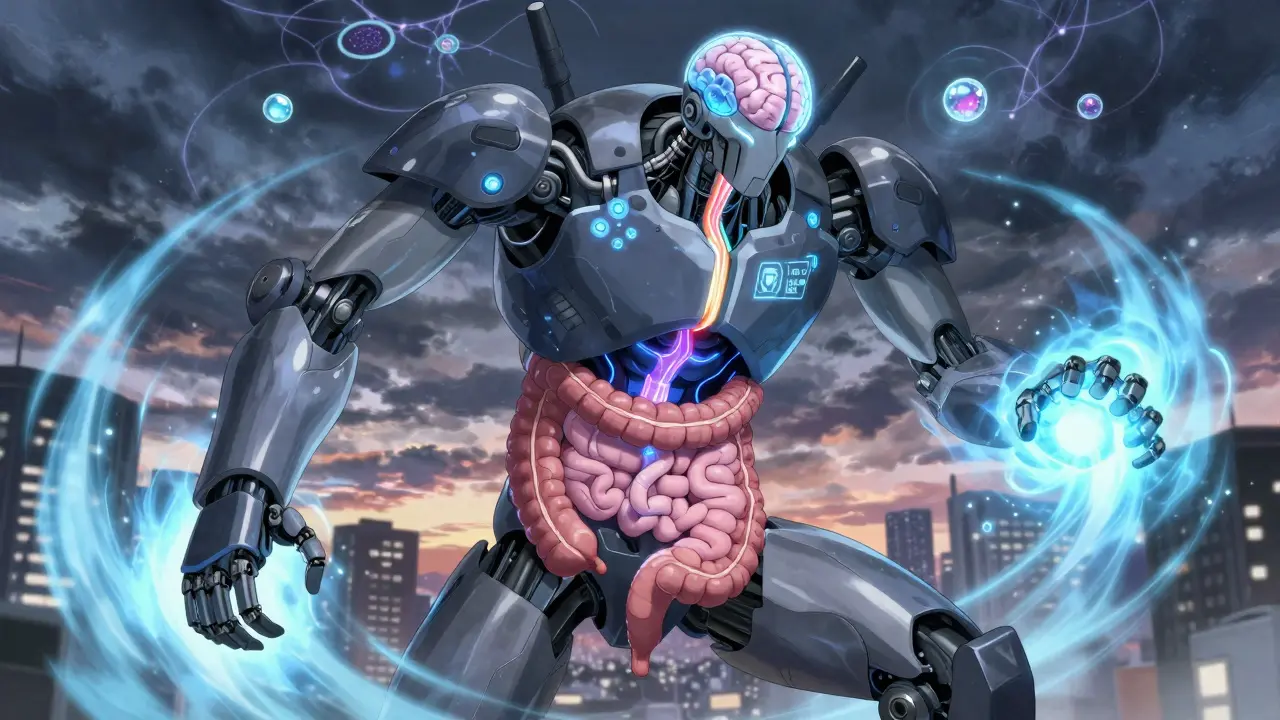
For millions of people worldwide, stomach pain, bloating, and erratic bowel habits aren’t just inconvenient-they’re life-limiting. If you’ve been told your symptoms are "just stress" or that your colon is "sensitive," you’re not alone. Irritable Bowel Syndrome (IBS) affects between 5% and 10% of the global population, yet most treatments still focus only on the gut. The truth? IBS isn’t a gut problem. It’s a gut-brain axis problem.
What the Gut-Brain Axis Really Is
The gut-brain axis isn’t a metaphor. It’s a two-way highway made of nerves, hormones, and immune signals connecting your digestive system to your brain. Your gut has its own nervous system-the enteric nervous system-with over 100 million neurons. That’s more than your spinal cord. These neurons talk to your brain through the vagus nerve, send chemical messages via serotonin and other neurotransmitters, and respond to immune signals from gut bacteria. In IBS, this highway gets jammed. Signals get distorted. Your brain starts misreading normal gut movements as pain. Your gut stops responding properly to stress. And your microbiome-trillions of bacteria living in your intestines-stops sending the right signals back. Brain scans of IBS patients show clear differences. People with diarrhea-predominant IBS (IBS-D) have thicker brain areas linked to sensing body signals. Those with constipation-predominant IBS (IBS-C) show thinner regions tied to emotional regulation. These aren’t random changes. They’re direct results of ongoing gut-brain miscommunication.Why Your Symptoms Don’t Match Your Tests
If you’ve had colonoscopies, blood tests, and stool analyses-all normal-you’re not being imagined. IBS doesn’t show up on scans because it’s not about damage. It’s about dysfunction. The Rome IV criteria, used by doctors worldwide, diagnose IBS based on symptoms: abdominal pain at least once a week for three months, linked to bowel movements or changes in stool form or frequency. But here’s what most doctors don’t tell you: 76% of IBS patients feel discomfort without pain. 60-70% also struggle with anxiety or depression. Nearly half have chronic headaches, back pain, or bladder issues. These aren’t separate conditions. They’re all part of the same broken system. Serotonin plays a huge role. About 95% of your body’s serotonin is made in your gut-not your brain. In IBS-D, mucosal serotonin levels are nearly 60% higher than in healthy people. That’s why laxatives and anti-diarrheals often fail-they don’t fix the root issue. In IBS-C, serotonin is too low, slowing everything down. It’s not about what you eat. It’s about how your nervous system reacts to it.How Diet Triggers the Gut-Brain Cycle
The low-FODMAP diet works for 50-76% of IBS patients. But why? It’s not because FODMAPs are "bad." It’s because they ferment quickly in the small intestine, drawing water in and producing gas. That distends the gut wall. In a healthy person, that’s fine. In someone with IBS, the brain interprets that stretch as pain. Studies show that even when FODMAPs are removed, symptoms improve because the gut stops sending alarm signals to the brain. But the diet isn’t a cure. It’s a tool to quiet the noise. The real challenge? The elimination phase lasts 4-6 weeks. Many people quit because it’s confusing, restrictive, and expensive. Working with a dietitian who understands IBS isn’t a luxury-it’s essential. And it’s not just food. Stress, sleep, and emotions directly affect gut function. A stressful day can trigger cramping. Poor sleep can worsen bloating. This isn’t "all in your head." It’s your head and gut being wired together-and when one goes off, the other follows.
Proven Ways to Reset the Gut-Brain Connection
There are three evidence-backed approaches that actually target the gut-brain axis-not just mask symptoms. Gut-directed hypnotherapy is the most effective treatment for many. In clinical trials, 70-80% of patients report major symptom improvement. It’s not about relaxation. It’s about retraining your brain to stop interpreting normal gut activity as dangerous. Sessions involve guided imagery where you visualize your gut calming down. Effects last at least six months, often longer. The catch? It’s hard to find. Only one certified practitioner exists for every 500,000 people in rural areas. Online programs are becoming more reliable. Specific probiotics like Bifidobacterium infantis 35624 have been shown to reduce bloating and pain in 30-40% of users. Not all probiotics work. Most over-the-counter brands don’t contain the right strains or doses. Look for products with clinical trials behind them. Neuromodulation is the new frontier. Transcutaneous vagus nerve stimulation (tVNS)-a small device worn on the ear-has shown 45-55% pain reduction in early studies. It’s non-invasive, affordable, and gaining FDA attention. Clinical trials are ongoing, but early results are promising. Pharmaceutical options like alosetron (for IBS-D) and prucalopride (for IBS-C) help some, but come with risks. Alosetron can cause dangerous intestinal blockages. Prucalopride may raise blood pressure. These are last-resort options, not first-line fixes.Why Most Treatments Fail
Most people try antispasmodics, laxatives, or antidiarrheals first. These drugs treat symptoms, not causes. They don’t fix the brain-gut miscommunication. In fact, 63% of IBS patients report side effects from these medications. Nearly half quit within three months because the relief is temporary-or worse, they feel worse. Another problem? Misinformation. Many patient resources oversimplify the gut-brain axis as "stress causes IBS." That’s misleading. It’s not stress alone. It’s how your nervous system has learned to respond to stress, food, and gut signals over time. You didn’t cause this. Your body did. The good news? Understanding the gut-brain axis changes everything. A 2022 survey of 45,000 IBS patients found those who learned how their brain and gut connect had 30% better treatment adherence and 25% greater symptom improvement. Knowledge isn’t just power-it’s healing.
Where to Start Today
You don’t need to fix everything at once. Start here:- Learn the basics. Read the Rome IV criteria. Understand that IBS is a real, measurable dysfunction-not a psychological issue.
- Track your symptoms. Use a simple app or journal. Note pain, stool type, food, sleep, and stress levels. Patterns will emerge.
- Try a low-FODMAP diet with guidance. Don’t go it alone. Find a dietitian who specializes in IBS. The goal isn’t to eliminate forever-it’s to identify triggers.
- Explore gut-directed hypnotherapy. Look for certified programs online. Many offer 8-week digital courses. If you’re skeptical, try one session. The results speak for themselves.
- Consider a targeted probiotic. Choose Bifidobacterium infantis 35624. Take it daily for at least four weeks. Track changes.
The Future of IBS Treatment
The IBS market is shifting fast. In 2023, the first gut-brain axis biomarker panel-called VisceralSense™-was launched. It measures 12 microbial metabolites and neurotransmitter ratios to predict which treatment will work for you. It’s 85% accurate. That’s not science fiction. It’s here. The NIH just launched a $15 million project to build personalized IBS treatment plans based on your unique gut-brain profile. In five years, you might get a simple stool test and a brain scan, then get a custom protocol-diet, probiotic, therapy, or device-tailored to your biology. For now, the best thing you can do is stop treating IBS like a gut problem. Start treating it like a nervous system problem. Because that’s what it is.What You Can Do Right Now
If you’re tired of guessing, here’s your action plan:- Stop blaming yourself. IBS isn’t your fault.
- Stop chasing quick fixes. Antispasmodics and laxatives won’t fix the root issue.
- Start learning. Read about the gut-brain axis. Watch videos from UCLA’s Center for Neurobiology of Stress.
- Start tracking. Use a symptom diary for two weeks.
- Start small. Try one probiotic. Try one low-FODMAP meal. Try one guided hypnotherapy session.
Is IBS just stress in the gut?
No. While stress can make symptoms worse, IBS isn’t caused by stress alone. It’s a disorder of the gut-brain axis, where signals between the digestive system and brain become distorted. Brain scans show physical changes in how IBS patients process pain and gut activity. Stress triggers symptoms, but the root cause is a miscommunication in your nervous system.
Can probiotics cure IBS?
No probiotic cures IBS. But certain strains, like Bifidobacterium infantis 35624, have been shown in clinical trials to reduce bloating and abdominal pain in 30-40% of people with IBS. Most over-the-counter probiotics don’t contain the right strains or doses. Look for products with published research behind them, and take them consistently for at least four weeks.
Why does the low-FODMAP diet work if it’s so restrictive?
FODMAPs are short-chain carbs that ferment quickly in the gut, pulling water in and producing gas. In people with IBS, this causes distension-and the brain interprets that as pain. The low-FODMAP diet doesn’t fix the gut. It quiets the signals sent to the brain. After the elimination phase, you gradually reintroduce foods to find your personal triggers. It’s not meant to be permanent.
Is gut-directed hypnotherapy really effective?
Yes. In randomized trials, 70-80% of IBS patients report major symptom improvement after gut-directed hypnotherapy-far better than standard medications. It works by retraining the brain to stop interpreting normal gut movements as dangerous. Effects last at least six months, and many people stay symptom-free for years. The challenge is finding a certified provider, but online programs are now reliable and widely available.
Will I ever be free of IBS symptoms?
Many people achieve long-term remission. IBS isn’t a disease you’re stuck with forever. It’s a dysfunctional signaling system-and like any system, it can be reset. With the right combination of diet, therapy, and lifestyle changes, most people significantly reduce or eliminate symptoms. It takes time, patience, and the right approach-but recovery is possible.
Pankaj Singh
January 12, 2026 AT 17:47This article is pure pseudoscience dressed up like medicine. Gut-brain axis? Please. IBS is just a fancy term for people who can't handle spicy food or caffeine. You don't need hypnotherapy-you need to stop being a hypochondriac and eat like a normal human being. All this biomarker nonsense? Just Big Pharma's way of selling you another $200 test.
jefferson fernandes
January 14, 2026 AT 12:34I’ve been living with IBS for 14 years-and this is the first time I’ve read something that actually makes sense. The gut-brain axis isn’t just a buzzword; it’s biology. I tried the low-FODMAP diet, skipped the probiotics, and then found a certified hypnotherapy program online. After 6 weeks? My bloating dropped by 80%. I’m not saying it’s easy-but it’s real. If you’re reading this and still thinking it’s ‘all in your head’-you’re part of the problem.
Trevor Davis
January 14, 2026 AT 14:39Wow. Just... wow. I’m not even sure where to begin. I’ve had IBS since college, and I’ve seen every specialist under the sun-from gastroenterologists to holistic healers. But this? This is the first time someone explained it like I’m not broken, just wired differently. The serotonin thing? Mind-blowing. I never realized my gut was making 95% of it. I’m going to start tracking my sleep and stress now. Thank you for writing this. I feel seen.
Acacia Hendrix
January 15, 2026 AT 00:06While the article does offer a commendable synthesis of current neurogastroenterological paradigms, it remains critically deficient in addressing the epistemic limitations of the Rome IV criteria as a phenomenological construct. The conflation of neuroplasticity with symptom modulation, while rhetorically persuasive, lacks rigorous biomarker validation. Furthermore, the uncritical endorsement of tVNS as a therapeutic modality-despite its phase II status-represents a dangerous precedent in translational medicine. One must interrogate the ontological status of the ‘gut-brain axis’ itself: is it a physiological pathway, or merely a heuristic?
Rosalee Vanness
January 15, 2026 AT 04:49Oh my god, I’ve been waiting for someone to say this out loud. I used to think I was crazy because I’d get stomach cramps after a bad day at work-or even after watching a sad movie. My doctor just handed me Imodium and told me to chill out. But this? This is the missing piece. I started a low-FODMAP meal plan with a dietitian, took the Bifidobacterium infantis for six weeks, and did a 10-minute hypnotherapy app every night before bed. It didn’t fix me overnight-but slowly, like a tide pulling back, the pain started to fade. I’m not cured. But I’m not drowning anymore. And that’s enough for today.
Scottie Baker
January 16, 2026 AT 16:04Oh here we go. Another ‘gut-brain axis’ cultist. You think you’re special because you found a YouTube video that says your colon is ‘miscommunicating’? Newsflash: your gut doesn’t have feelings. You’re stressed, you eat garbage, and now you’re spending $300 on probiotics because you’re too lazy to just eat less dairy. Hypnotherapy? Really? Next you’ll be chanting to your colon. Get a grip.
Anny Kaettano
January 18, 2026 AT 08:02Thank you for writing this with such clarity and compassion. I’ve spent years feeling dismissed by doctors who called me ‘anxious’-as if my pain was imaginary. But this? This is validation. I’ve been doing the low-FODMAP diet for 8 months now, and I finally found my triggers: onions and apples. I also started a daily tVNS device-I wear it while I read. It’s not magic, but it’s science. And for the first time, I’m not ashamed of my body. You’re not alone. We’re all just trying to listen to what our guts are trying to tell us.
Jesse Ibarra
January 20, 2026 AT 06:39Let me be the first to say this: if you’re still trusting Big Pharma’s ‘gut-brain axis’ fairy tale, you’re being played. This isn’t science-it’s spiritual marketing for the modern age. You want to fix your gut? Stop eating processed crap. Stop Googling symptoms. Stop buying $50 probiotics. Eat real food. Move your body. Sleep. That’s it. Everything else? Just noise. And if you’re paying for hypnotherapy? You’ve already lost.
Randall Little
January 21, 2026 AT 07:27Interesting. But let’s pause for a second. The article cites a 2022 survey of 45,000 IBS patients-but doesn’t specify methodology. Was it peer-reviewed? Self-reported? Did they control for placebo effect? Also, ‘VisceralSense™’? That sounds like a startup name, not a biomarker panel. And where’s the citation? I’m not saying it’s wrong-I’m saying if you’re going to drop terms like ‘neurotransmitter ratios,’ you better back them up with DOI links. Otherwise, this is just well-written fluff.
John Tran
January 21, 2026 AT 23:51So… the gut talks to the brain? And the brain talks back? And somehow… we’re all just… confused messengers? Like… we’re all just little neurons screaming into the void? I mean, I get it. I’ve had IBS since I was 12. I’ve cried in bathrooms at concerts. I’ve missed weddings because my stomach was a warzone. But this? This article made me feel like my body isn’t broken-it’s just… trying to speak, and no one’s listening. And maybe… maybe we’re all just trying to hear each other. I don’t know. I’m just… crying now. And I think that’s okay.
Robin Williams
January 22, 2026 AT 00:01Stop fighting your gut. It’s not your enemy. It’s your oldest friend. It’s been digesting your trauma, your stress, your joy, your grief-long before you even knew what those words meant. You don’t need to ‘fix’ it. You need to listen. Start with one meal. One breath. One day. Not tomorrow. Today. Your body’s been waiting for you to show up. It’s not broken. It’s just tired. And it’s ready to heal-if you let it.
Kimberly Mitchell
January 23, 2026 AT 18:03Another overhyped, under-evidenced piece of wellness propaganda. The low-FODMAP diet works for some, sure-but it’s not a cure. Probiotics? Most are garbage. Hypnotherapy? Sounds like a cult. And ‘VisceralSense™’? That’s not a real thing. I’ve read the literature. None of this holds up under scrutiny. Just eat less fiber, drink more water, and stop wasting money on nonsense.