
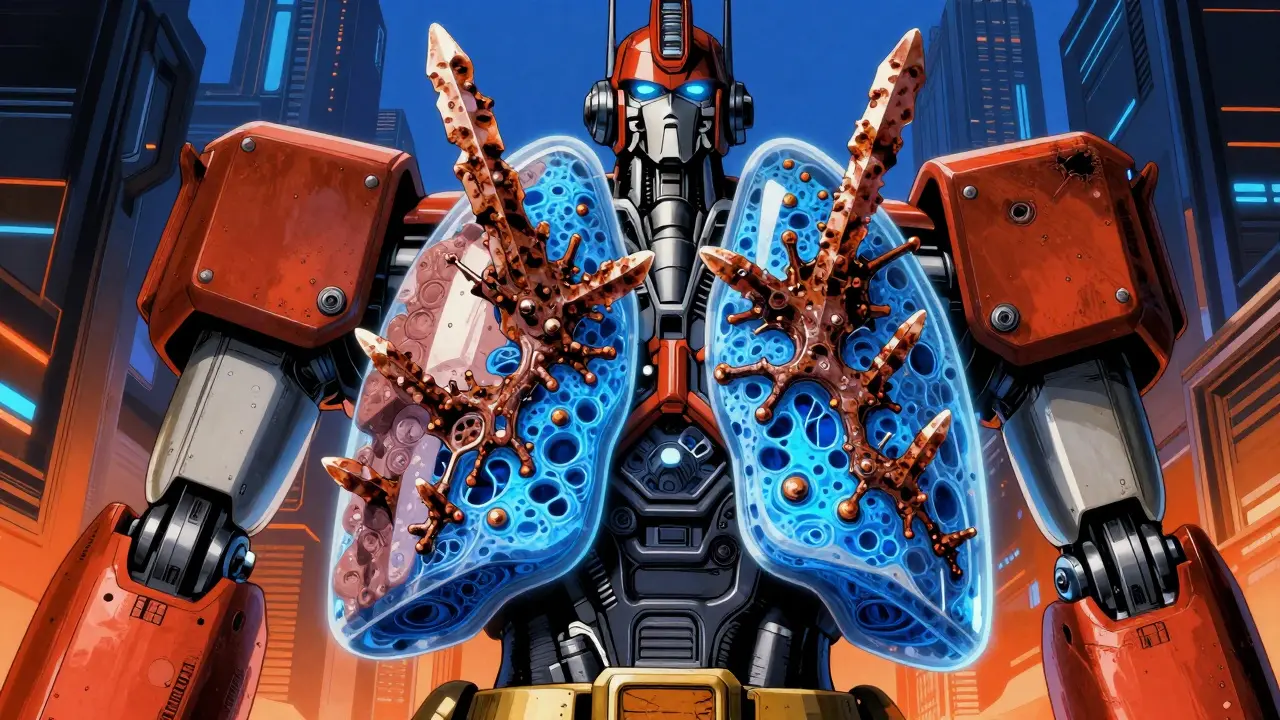
Imagine your lungs as a delicate sponge designed to swap oxygen for carbon dioxide. Now, imagine that sponge slowly turning into stiff, leather-like scar tissue. That is the reality of Interstitial Lung Disease is an umbrella term for over 200 disorders that cause inflammation and progressive scarring in the interstitium-the vital tissue and space surrounding the air sacs in your lungs. When this tissue thickens, your lungs can't expand fully, and oxygen struggles to reach your bloodstream. Because this damage is typically irreversible, the goal isn't to "cure" the scarring but to slow it down and keep you breathing easier for longer.
The Reality of Lung Scarring and Fibrosis
In a healthy lung, the interstitium is incredibly thin-usually less than 0.1mm. However, when Pulmonary Fibrosis (the medical term for lung scarring) takes over, that tissue can thicken to 2mm or more. This creates a physical barrier that blocks oxygen from entering the blood, leading to a state of chronic respiratory insufficiency.
For most people, the symptoms sneak up. You might first notice a slight shortness of breath while climbing stairs or gardening-what doctors call exertional dyspnea. Over time, this can progress to feeling winded even while sitting still. About 78% of people with these conditions also deal with a persistent dry cough that doesn't go away with standard cold medicine. As the disease advances, some develop "clubbing," where the fingertips widen and the nails curve downward, a sign that the body is struggling with low oxygen levels.
Understanding the Different Types of ILD
Not all interstitial lung diseases are created equal. Some are caused by things we breathe in, while others happen for no apparent reason. Knowing the subtype is critical because a treatment that works for one might be useless for another.
Idiopathic Pulmonary Fibrosis (IPF) is the most common form, making up about 20-30% of cases. "Idiopathic" simply means the cause is unknown. Unfortunately, IPF tends to be more aggressive, with a faster decline in lung function compared to other types. On the other hand, ILD linked to autoimmune issues, like rheumatoid arthritis, often progresses more slowly.
Then there is Sarcoidosis, where small clumps of inflammatory cells form in the lungs. Interestingly, about 60-70% of sarcoidosis cases resolve on their own within two years. Contrast that with drug-induced ILD, which usually improves quickly once the offending medication is stopped, or asbestosis, which is a slow-burn result of environmental exposure.
| Subtype | Approx. Prevalence | Progression Speed | Common Outcome |
|---|---|---|---|
| IPF | 20-30% | Fast | Progressive decline |
| Sarcoidosis | 15% | Variable | Often resolves spontaneously |
| Connective Tissue ILD | Varies | Slow to Moderate | Managed via autoimmune therapy |
| Environmental (e.g., Asbestosis) | 15-20% | Slow | Permanent, slow-growing fibrosis |
How Doctors Diagnose the Damage
Getting a correct diagnosis can be a frustrating journey. Many patients report being told their shortness of breath is just a sign of "aging" or "asthma" before finally seeing a specialist. In fact, some surveys show an average of over two misdiagnoses before the correct one is found.
The gold standard for spotting the scarring is High-Resolution Computed Tomography (HRCT). Unlike a standard X-ray, an HRCT takes 1mm slices of the lung, allowing radiologists to see subtle patterns of fibrosis. To be certain, most top clinics use a multidisciplinary approach where a pulmonologist, a radiologist, and a pathologist all review the images together.
Pulmonary function tests are also essential. Doctors look at your Forced Vital Capacity (FVC)-which measures how much air you can blow out-and your DLCO, which measures how well oxygen moves from your lungs into your blood. In moderate to severe cases, these values can drop by 30% to 60%, confirming that the lungs are becoming too stiff to function normally.

Treatment Options: Slowing the Slide
While we can't "un-scar" the lungs, we can put the brakes on the progression. For years, the only option was managing symptoms. Now, we have Antifibrotic Therapy, which targets the proteins that drive scarring.
The two main heavy hitters are Nintedanib (Ofev®) and Pirfenidone (Esbriet®). Clinical trials, such as the INPULSIS study, have shown that these drugs can slow the decline of lung function by about 50% over a year. However, they aren't without drawbacks. Many users of Pirfenidone report skin sensitivity to the sun and stomach issues, which often require dose adjustments.
The newest addition to the toolkit is zampilodib, approved in late 2023. It uses a different mechanism of action and has shown a 48% reduction in lung function decline in certain trials, offering hope to those who didn't respond well to older drugs.
Living with ILD: Beyond the Pharmacy
Medication is only one part of the puzzle. When your lungs aren't working, every movement takes more energy. This is where Pulmonary Rehabilitation comes in. These aren't just gym sessions; they are supervised programs that combine exercise, breathing techniques, and nutritional advice. Many patients find their walking distance improves by 45-60 meters after a 12-week program, which can be the difference between being able to walk to the mailbox or needing a wheelchair.
Eventually, many people need Supplemental Oxygen Therapy. This usually happens when resting oxygen saturation (SpO2) drops below 88%. While relying on an oxygen tank can feel limiting and cause anxiety, it is crucial for protecting the heart. When the lungs can't provide enough oxygen, the heart has to pump harder, which can lead to right-sided heart failure if left untreated.

Future Directions and Emerging Tech
We are moving toward a world of personalized medicine. Instead of a one-size-fits-all drug, doctors are starting to use genetic profiling. For example, testing for the MUC5B promoter polymorphism can help predict if a patient's disease will progress rapidly.
Artificial Intelligence is also changing the game. New AI-assisted HRCT analysis tools are now reaching 92% accuracy in distinguishing between different ILD subtypes, far surpassing the 78% accuracy of human radiologists alone. We are also seeing a surge in stem cell research and tyrosine kinase inhibitors, aiming to find treatments that might actually stabilize or even partially reverse some types of damage.
Can lung scarring from ILD be reversed?
In most cases, once lung tissue has turned into fibrosis (scar tissue), it is permanent and cannot be reversed. However, the inflammation that leads to scarring can often be treated, and antifibrotic medications can significantly slow down the creation of new scars, preserving your remaining lung function.
What is the difference between IPF and other ILDs?
Idiopathic Pulmonary Fibrosis (IPF) is a specific type of ILD where the cause is unknown. It is generally more aggressive and has a faster progression rate. Other ILDs may be caused by autoimmune diseases (like lupus), environmental toxins (like asbestos), or inflammation (like sarcoidosis), and they often respond differently to treatment.
When is supplemental oxygen necessary?
Oxygen therapy is typically prescribed when a patient's resting oxygen saturation (SpO2) levels consistently drop below 88%. This is vital to prevent organ damage and reduce the strain on the heart, especially during physical activity.
How does pulmonary rehabilitation help if the lungs are scarred?
While it cannot remove the scars, pulmonary rehabilitation trains your muscles to use oxygen more efficiently and teaches you breathing techniques to reduce the feeling of breathlessness. This improves your overall exercise tolerance and quality of life.
What are the most common side effects of antifibrotic drugs?
Pirfenidone is frequently associated with photosensitivity (increased risk of severe sunburn) and gastrointestinal issues like nausea. Nintedanib is more commonly linked to diarrhea. Most of these can be managed through dose adjustments or dietary changes.
Next Steps for Patients and Caregivers
If you or a loved one is struggling with breathlessness, don't settle for a generic diagnosis of "getting older." Request a referral to a pulmonologist specifically experienced in interstitial lung diseases. Ask about an HRCT scan if a standard chest X-ray was inconclusive.
For those already diagnosed, focus on a three-pronged approach: pharmacological management to slow the disease, pulmonary rehabilitation to maintain mobility, and early oxygen assessment to protect your heart. Keeping a daily log of your "walking distance" or "stairs climbed" can provide your medical team with better data than a once-a-year clinic visit, allowing them to adjust your treatment in real-time.