

Gene Therapy Drug Interaction Checker
Gene therapies can permanently alter how your body processes medications. This tool helps assess potential interactions based on your therapy type and current medications. Always consult your medical team before making any medication changes.
Interaction Assessment
Disclaimer: This tool provides general information only. It is not a substitute for professional medical advice. Always consult your healthcare team before making any medication changes.
Gene therapy promises to fix diseases at their source-by correcting faulty genes instead of just managing symptoms. But behind this breakthrough lies a hidden danger: how these therapies interact with everyday drugs. Unlike traditional medicines, gene therapies don’t just pass through your body. They change it. And those changes can turn common prescriptions into unpredictable, even dangerous, combinations.
Why Gene Therapy Isn’t Like Taking a Pill
Most drugs work by blocking or boosting a chemical process. You take them, they do their job, and they’re gone in hours or days. Gene therapy is different. It delivers new genetic instructions into your cells-often using modified viruses as delivery trucks. These viruses aren’t just carriers; they’re biological actors. Once inside, they can stick around for years, even decades, making proteins your body didn’t used to make. That permanence is the whole point. But it’s also the problem.When you mix gene therapy with other medications, you’re not just adding two chemicals together. You’re altering the entire environment those chemicals move through. Your liver might start metabolizing drugs faster. Your immune system might go into overdrive and block the drug from working. Or worse-your body might start attacking itself.
The 1999 Tragedy That Changed Everything
In 1999, 18-year-old Jesse Gelsinger died four days after receiving gene therapy for a rare metabolic disorder. He wasn’t the first to be treated, but he was the first to die. The therapy used an adenovirus to deliver a corrected gene to his liver. His immune system reacted violently. Within hours, his body went into cytokine storm-a total immune meltdown. Multiple organs failed. He didn’t survive.The tragedy wasn’t just in the death. It was in what was ignored before the trial. Earlier tests on monkeys showed the same deadly reaction. Two out of six died. But the trial went ahead anyway. Since then, every gene therapy trial has had to prove it can predict-and prevent-this kind of immune overreaction. But even today, we can’t reliably tell who’s at risk.
When the Therapy Itself Causes Cancer
In the early 2000s, another shockwave hit the field. Children with severe immune deficiencies were being treated with gene therapy using retroviral vectors. Most responded well-some even regained full immune function. But five of those children later developed leukemia. The therapy didn’t just fix a broken gene. It accidentally turned on a cancer gene.The viral vector slipped into the wrong spot in the DNA-right next to LMO2, a gene that controls cell growth. The new gene’s activity accidentally switched LMO2 on permanently. The cells started dividing nonstop. One child died. The others needed aggressive treatment. This wasn’t a side effect. It was a direct result of how the therapy integrated into the genome.
That’s why today’s therapies avoid retroviral vectors for most applications. Newer tools like AAV (adeno-associated virus) are preferred because they mostly stay outside the DNA. But even AAV isn’t perfect. It can still insert itself randomly. And when it does, the risk of cancer doesn’t vanish-it just gets delayed.
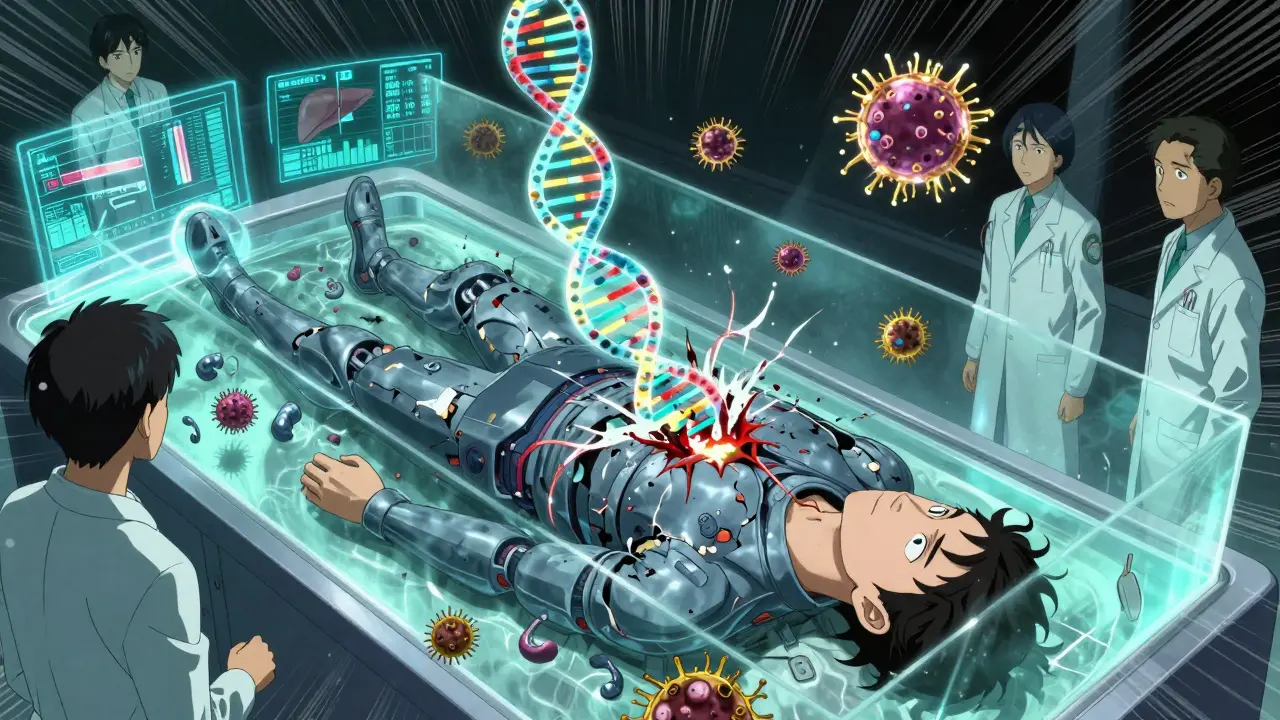
Drug Metabolism Gets Turned Upside Down
Your liver uses enzymes-mainly from the CYP450 family-to break down drugs. If you’re on blood thinners, antidepressants, or statins, your body relies on these enzymes to keep levels safe. Now imagine gene therapy triggers inflammation. Suddenly, your liver ramps up or shuts down these enzymes. The result? A drug that used to work perfectly now builds up to toxic levels-or disappears before it can help.There’s no standard way to predict this. One patient might have a mild immune response and no change in drug levels. Another, with the same therapy, might see their cholesterol meds become completely ineffective. The variation comes from genetics, age, existing health conditions, and even gut bacteria. We don’t yet have a test to tell you which group you’re in.
Off-Target Effects Can Change How Your Body Processes Drugs
Gene therapy isn’t always precise. Even the best vectors can deliver genes to the wrong cells. A therapy meant for the eye might accidentally reach the liver. A treatment for muscle disease might tweak brain cells. That’s a problem if those off-target cells are involved in drug metabolism.Imagine a gene therapy that accidentally modifies liver cells to produce a growth factor. That growth factor could make liver cells divide faster. Now your liver processes drugs differently. Your painkillers last longer. Your diabetes meds stop working. You don’t know why. Your doctor doesn’t know why. And it might not show up for years.
Worse, if the therapy uses modified cells that are transplanted back into the body-like in some blood disorder treatments-those cells can migrate. A cell meant to fix sickle cell disease might end up in the pancreas. Now you’ve got a tiny patch of tissue that metabolizes insulin differently. That’s not something a routine blood test will catch.
Long-Term Monitoring Isn’t Optional-It’s Mandatory
Most drugs are monitored for 30 days after treatment. Gene therapy? The FDA requires 15 years of follow-up for therapies that integrate into DNA or can lie dormant. Why? Because some risks take years to show up.Leukemia from retroviral therapy showed up 2-5 years after treatment. Immune reactions to AAV vectors have appeared 3-7 years later. And we still don’t know what happens at year 10 or 12. That’s why patients who get gene therapy are tracked for life. Their medication lists are reviewed every year. Blood tests check for liver stress, immune markers, and unexpected gene expression.
There’s no checklist for this. No app to scan your prescriptions and warn you. It’s all manual. You have to tell every doctor you see-dentist, psychiatrist, ER staff-that you’ve had gene therapy. Because a simple antibiotic could become dangerous if your liver’s metabolism has changed.

What Happens If the Therapy Spreads?
Here’s a scenario no one talks about much: what if the therapy spreads to someone else?Some viral vectors can be shed in saliva, sweat, or feces. In rare cases, family members or caregivers have picked up traces of the viral vector. That’s not infection-it’s accidental gene therapy. The person didn’t consent. They didn’t get screened. They might have a hidden condition that makes them vulnerable.
The FDA now requires companies to prove their vectors won’t transmit. But the data is limited. And for therapies using live viruses-like modified herpes simplex for brain tumors-the risk is higher. We’re still learning how often this happens. But we know it can.
What Can Patients Do Right Now?
If you’re considering gene therapy-or already had it-here’s what you need to do:- Keep a complete, updated list of every medication you take-prescription, over-the-counter, supplements, even herbal teas.
- Tell every doctor you see, even if it’s just for a cold or a rash. Say: “I had gene therapy in [year]. I don’t know how it affects other drugs.”
- Get a baseline blood test before treatment, and repeat it every 6-12 months after. Look for changes in liver enzymes, immune markers, and drug levels.
- Don’t start new meds without consulting your gene therapy team. Even something as simple as St. John’s Wort can interfere.
- Join a long-term registry. Many centers track patients for decades. Your data helps others.
The Future: Can We Predict These Interactions?
Right now, we’re flying blind. We don’t have models to predict how gene therapy will interact with, say, warfarin or metformin. We don’t know how your unique genes affect your response. We don’t know how age, diet, or gut microbes play into it.But research is moving fast. Teams in the U.S., Europe, and Australia are building databases that link gene therapy types with drug outcomes. Some are using AI to predict immune responses based on a patient’s genetic profile. Others are testing wearable sensors that monitor inflammation in real time.
One day, we might have a simple blood test that tells you: “Your gene therapy makes you 70% more likely to have a bad reaction to ibuprofen.” But that day isn’t here yet.
For now, the safest approach is caution. Gene therapy is powerful. But power without understanding is dangerous. Every drug interaction isn’t a crisis. But each one is a warning. And we’re only just beginning to listen.
Can gene therapy cause long-term side effects from drug interactions?
Yes. Because gene therapy can permanently alter how your body works, drug interactions may not show up for years. Changes in liver enzyme activity, immune responses, or off-target gene expression can delay the effects of medications, making them too strong, too weak, or toxic. That’s why 15-year follow-ups are required for many therapies.
Are all gene therapies the same when it comes to drug interactions?
No. Viral vectors like AAV, adenovirus, and lentivirus behave very differently. AAV tends to stay outside the DNA and causes fewer integration risks, but it can still trigger strong immune reactions. Retroviral vectors integrate into DNA and carry higher cancer risks. Non-viral methods are newer and less understood. Each type has its own interaction profile.
Should I stop taking my medications before gene therapy?
Never stop medications without consulting your care team. Some drugs, like immunosuppressants, are given before or after gene therapy to reduce immune reactions. Others may need to be paused temporarily. But stopping things like blood pressure or diabetes meds can be dangerous. Always follow your doctor’s specific plan.
Can gene therapy affect how my body responds to vaccines?
Possibly. Since gene therapy can alter immune function, your response to vaccines-especially live ones-could be stronger, weaker, or unpredictable. Some patients have shown reduced antibody response after AAV therapy. Others developed unusual inflammation after flu shots. Always tell your vaccine provider about your therapy history.
Is there a database I can check to see if my drug interacts with gene therapy?
Not yet. There are no publicly available databases that list drug-gene therapy interactions because the data is still too new and fragmented. Most hospitals with gene therapy programs maintain internal lists based on their own patients. Your best resource is your gene therapy center-they track this information for you.
How often should I get checked after gene therapy?
For the first year, expect monthly or quarterly checkups. After that, annual visits are standard. But if you’re on long-term medications, you may need blood tests every 6 months to monitor liver function, immune markers, and drug levels. Some centers recommend lifelong monitoring, especially if your therapy uses integrating vectors.
Brian Furnell
December 22, 2025 AT 04:32Okay, so let me get this straight: we’re inserting viral vectors into humans, and the assumption is that they’ll behave like predictable pharmaceuticals? That’s like handing someone a loaded gun and saying, ‘Just don’t pull the trigger.’ The permanence of gene edits means we’re essentially creating living, breathing pharmacokinetic wildcards-every cell becomes a potential variable. And we’re not even close to mapping the off-target integration hotspots across diverse genomic landscapes. The CYP450 disruption alone? That’s not a side effect-it’s a systemic reprogramming event, and we’re treating it like a footnote.
And don’t even get me started on the shedding risk. If your AAV vector ends up in your kid’s saliva, and they’ve got an undiagnosed immunodeficiency, you’ve just administered unconsented gene therapy. That’s not science-that’s bioethical roulette. We need mandatory genetic screening for household members, not just ‘please tell your dentist.’
The 1999 Gelsinger case wasn’t an anomaly-it was a warning sign painted in neon, and we still haven’t installed the fire alarms.
Siobhan K.
December 23, 2025 AT 15:28So let me summarize: we’re giving people permanent genetic upgrades that might turn their liver into a drug-processing black hole, and then we expect them to remember to tell every doctor they’ve ever met-including the one who pulls their wisdom tooth-that they’re basically a walking clinical trial? Brilliant. Just brilliant. No app, no database, no safety net-just a printed list you hope doesn’t get lost in the ER chaos. Meanwhile, Big Pharma is already pricing these therapies at $2M per patient. Someone’s making money. Just not the patient.
Meina Taiwo
December 24, 2025 AT 14:17Gene therapy changes how drugs work. Always tell doctors. Monitor liver enzymes. Keep records.
Jon Paramore
December 25, 2025 AT 15:48AAV serotype matters more than most realize. AAV8 targets liver aggressively; AAV9 crosses the BBB. If you’re on statins and get an AAV8-based therapy for familial hypercholesterolemia, you’re looking at CYP3A4 suppression-potentially doubling simvastatin half-life. We’ve seen this in Phase I. But without pharmacogenomic baseline data, you’re guessing. And guesswork kills. We need pre-treatment CYP phenotyping, not just ‘here’s your consent form.’
Also-don’t ignore gut microbiome interactions. Certain bacterial strains metabolize bile acids that regulate CYP expression. If your microbiome shifts post-therapy, your drug clearance changes. We’re not even measuring this yet.
Swapneel Mehta
December 25, 2025 AT 20:00I’ve been following this field since the early 2000s. It’s scary, but also hopeful. We’ve come so far from those retroviral disasters. Today’s therapies are way more precise. Yes, the unknowns are real-but so is the potential. I know someone who got treated for beta-thalassemia and hasn’t needed transfusions in five years. That’s life-changing. We just need to be smart, not scared. Stay informed, stay vigilant, but don’t lose sight of the wins.
Adrian Thompson
December 26, 2025 AT 21:46They’re not telling you the whole truth. Gene therapy isn’t medicine-it’s a Trojan horse for bio-surveillance. The vectors? They’re tracking you. The FDA’s 15-year rule? That’s not for safety-it’s to monitor how your DNA reacts to the chip implants they’re secretly layering in. They want to control your metabolism. Your meds? Your insulin? Your blood pressure? All remotely adjustable. This isn’t science. It’s control. And you’re signing the papers.
St. John’s Wort? That’s the only thing keeping you sane. Don’t let them take it away.
Southern NH Pagan Pride
December 27, 2025 AT 01:32Okay, so we're letting corporations inject us with modified viruses that can alter our DNA forever... and the government says 'trust us' because they 'tested it on monkeys'? And now we're supposed to tell our ENT about it? What if the ENT is part of the program? What if the 'baseline blood test' is just collecting your genetic data for the biometric database? They're calling it 'monitoring'-but it's surveillance. And they're using 'cancer risk' as an excuse to make us compliant. Don't be fooled. This isn't healing. It's programming.
John Hay
December 27, 2025 AT 04:38Look, I get the fear. But if you’re sitting there scared to take a Tylenol because you had gene therapy, you’re letting anxiety kill you faster than any drug interaction. I’ve been on a gene therapy protocol for three years. I take ibuprofen, antidepressants, and antibiotics. I told every doctor. I got baseline labs. I’m alive. The system isn’t perfect-but it’s working for people who are proactive. Don’t let fear paralyze you. Stay informed, stay honest with your care team, and don’t stop living.
Christina Weber
December 28, 2025 AT 08:15It’s astonishing how casually people treat the notion of permanent genomic modification as if it were a new flavor of yogurt. The fact that we lack standardized, peer-reviewed, longitudinal databases tracking drug-gene therapy interactions across diverse populations is not just negligent-it’s indefensible. Moreover, the continued use of AAV vectors despite documented off-target integration events in non-dividing cells constitutes a gross violation of the precautionary principle. Until we implement mandatory pre-treatment whole-genome sequencing, pharmacogenomic profiling, and a centralized, transparent global registry-this is not medicine. It’s human experimentation with a glossy brochure.
Cara C
December 29, 2025 AT 06:16Thank you for writing this. I’ve been helping patients navigate this since 2020, and the fear is real-but so is the hope. One thing I always tell them: you’re not alone. Your care team is there to help you manage this, not just to deliver the therapy. Keep that list. Tell every provider-even the acupuncturist. And if you feel overwhelmed, reach out to a patient advocate. There are people who’ve been through this. We’re learning together. You don’t have to figure it all out alone.