

It’s a common worry: you switch from a brand-name pill to a cheaper generic, and suddenly you feel off. Maybe your blood pressure spikes, your anxiety flares, or you get stomach pain where you never had it before. You start wondering - do generics interact differently than the brand-name drugs you used to take?
The short answer? No. Not really. But the reason you feel something changed? That’s where things get messy.
Why You Think Generics Are Different
You’re not crazy for thinking this. A 2022 Kaiser Family Foundation survey found nearly half of patients believe generics don’t work the same as brand-name drugs. And it’s not just fear - it’s experience. People report side effects they never had before switching. But here’s the catch: in 90% of those cases, the problem isn’t the drug itself. It’s something else.
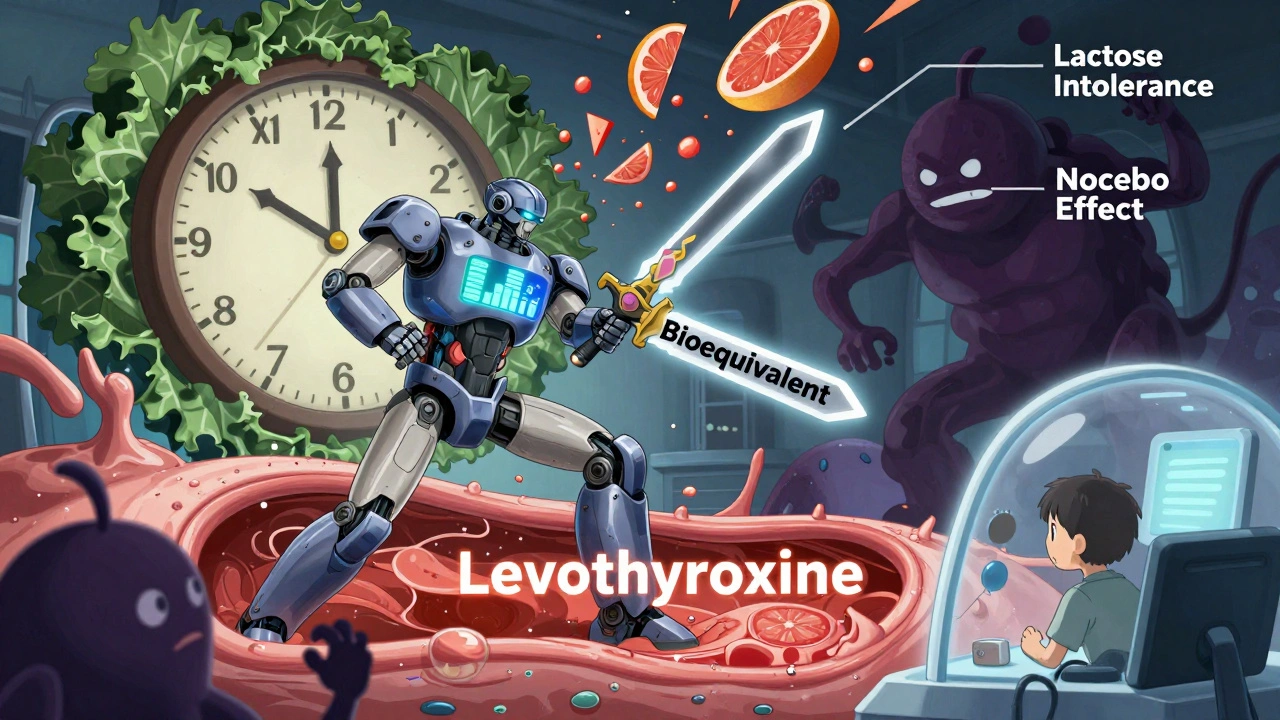
Let’s say you’ve been taking levothyroxine for hypothyroidism for years. Your brand-name version worked perfectly. Then your pharmacy switches you to a generic. Now you’re jittery, your heart races, and your TSH levels are all over the place. You assume the generic is faulty. But what if the generic uses lactose as a filler, and you’ve developed a mild lactose intolerance since your last doctor visit? Or what if you started eating more kale and broccoli, which interfere with thyroid absorption? The drug didn’t change. Your body did.
This is called the nocebo effect - the opposite of placebo. If you believe a generic is inferior, your brain can make you feel worse, even if the medicine is chemically identical. Studies show patients report more side effects with generics simply because they expect to. It’s psychological, not pharmacological.
What Actually Causes Drug Interactions
Drug interactions happen because of the active ingredient - the part that actually does the work in your body. Whether it’s made by Pfizer, Teva, or a small lab in India, if the active ingredient is the same, the interaction profile is the same.
Take warfarin, a blood thinner with a narrow therapeutic window. A 10% change in dose can mean the difference between a clot and a bleed. The FDA requires generic versions of warfarin to be within 90-112% of the brand-name bioavailability - tighter than the usual 80-125% range. That’s because even small changes matter. But here’s the truth: if your INR levels go wild after switching generics, it’s far more likely you ate more vitamin K-rich food, skipped a dose, or started a new antibiotic than it is that the generic is flawed.
Same goes for statins. Fluconazole, an antifungal, can spike simvastatin levels by 300-400%. That’s dangerous. But it doesn’t matter if your simvastatin is Lipitor or the generic version. The interaction is with the active ingredient - simvastatin - not the brand name.
Even food interactions don’t care about labels. Grapefruit juice blocks an enzyme called CYP3A4, which breaks down dozens of drugs. Calcium channel blockers, statins, some anti-anxiety meds - they all get affected. Again, whether it’s a brand or generic version of the drug, grapefruit juice will do the same thing.
The Real Culprit: Inactive Ingredients
So if the active ingredient is identical, why do some people react differently? The answer lies in the fillers - the stuff that holds the pill together. These are called excipients: lactose, corn starch, sodium benzoate, dyes, even gluten.
Brand-name manufacturers stick to the same excipients for years. Generic makers? They change suppliers all the time to cut costs. One batch of generic sertraline might use sodium benzoate. The next batch? Hydrochloride salt. That’s fine for most people. But if you’re sensitive to benzoates - and some people are - you might get headaches, nausea, or skin rashes. Not because the drug stopped working. Because your body reacted to something new in the pill.
In 2021, a patient in the U.S. reported severe GI distress after switching from brand-name levothyroxine to a generic. Turns out, the generic used lactose. The patient had never had a problem before - but recently developed a mild intolerance. The brand-name version used a different filler. The drug worked the same. The filler didn’t.
These cases are rare. The FDA tracked over 1.2 million generic prescriptions in 2023 and found only 0.03% of adverse events were linked to excipient-related issues. But when they happen, they’re real. And they’re avoidable.
When to Be Extra Careful
Not all drugs are created equal. Some have what’s called a narrow therapeutic index - meaning the difference between a helpful dose and a dangerous one is tiny. For these, consistency matters more.
Drugs like:
- Warfarin (blood thinner)
- Levothyroxine (thyroid hormone)
- Phenytoin (seizure control)
- Digoxin (heart rhythm)
- Cyclosporine (organ transplant)
For these, the FDA and the American Society of Health-System Pharmacists recommend sticking with the same generic manufacturer - or even better, the same brand - if possible. Why? Because even small differences in how the drug is absorbed can add up over time. It’s not that generics are unsafe. It’s that for these drugs, your body needs stability.
Hospitals know this. Over 75% of U.S. hospitals use a single generic manufacturer for these critical drugs. They don’t switch unless they have to. That’s not because generics are bad. It’s because precision matters.
What You Can Do
If you’re on a high-risk medication, here’s what works:
- Ask your pharmacist: “Which generic manufacturer is this?” Write it down. If you switch and feel different, check if the manufacturer changed.
- Don’t assume a new generic is bad. Look for lifestyle changes first: new foods, new supplements, skipped doses, alcohol, or other meds.
- Keep a simple log: date, drug, dose, how you felt, what you ate. This helps your doctor spot patterns.
- If you’re switching from brand to generic, give it 2-4 weeks. Your body needs time to adjust, even if the drug is identical.
- Never stop or change your dose because you think the generic “doesn’t feel right.” Talk to your doctor first.
And if you’re switching back and forth between generics? That’s a problem. A 2022 IQVIA study found one in three U.S. prescriptions switch generic manufacturers within a year. That’s not a flaw in the system - it’s a flaw in how we manage care. Every switch risks exposure to new fillers. For most people, it’s harmless. For a few, it’s enough to trigger a reaction.

What the Experts Say
Dr. Michael Cohen of the Institute for Safe Medication Practices put it bluntly: “The active ingredient determines drug interactions, not whether it’s generic or brand-name.”
The FDA agrees. All generic drugs must prove they’re bioequivalent to the brand. They must carry the same interaction warnings. Their labels are reviewed and approved by the same team. In 2023, the FDA found 97.4% of generics met exact equivalence standards. Only 1.2% needed extra testing - and those were mostly for high-risk drugs.
And yet, the myth persists. Why? Because it’s easier to blame the pill than to admit your diet changed, your sleep got worse, or you started taking turmeric for “inflammation” - which can interfere with blood thinners.
The Bigger Picture
Generics make up 90% of all prescriptions in the U.S. They saved $3.4 trillion over the last decade. Without them, millions couldn’t afford their meds. But perception is a powerful thing. A 2023 Health Affairs study found that 1.2 million unnecessary brand-name prescriptions are filled every year - not because they’re better, but because patients fear generics.
That costs the system $8.7 billion. And for what? For peace of mind that’s often built on misunderstanding.
The science is clear: generics are safe. They’re effective. They interact the same way. But your body is complex. And sometimes, what looks like a drug interaction is really a mismatch between your lifestyle and your medicine.
The best defense? Knowledge. Ask questions. Track your symptoms. Don’t assume the worst. And if you’re on a high-risk drug - stick with the same version. Not because generics are risky. But because consistency is what keeps you safe.
Do generic drugs have the same interactions as brand-name drugs?
Yes. Generic drugs contain the same active ingredient as their brand-name counterparts and are required by the FDA to have identical interaction profiles. Whether it’s grapefruit juice, antibiotics, or other medications, the interaction depends on the active ingredient - not whether the drug is generic or brand-name.
Why do some people feel different on generic medications?
Most often, it’s not the drug - it’s the fillers. Generic manufacturers sometimes use different inactive ingredients (like lactose or dyes), which can trigger reactions in sensitive people. Psychological factors also play a role: if you believe generics are inferior, your brain can amplify side effects - a phenomenon called the nocebo effect.
Are generics less safe for drugs like warfarin or levothyroxine?
No. Generics for these drugs are held to stricter bioequivalence standards (90-112% vs. the usual 80-125%). However, because small changes in dose can be dangerous, it’s wise to stick with the same manufacturer - brand or generic - to avoid variability in fillers or absorption. The drug itself isn’t less safe; consistency is key.
Can excipients in generics cause real side effects?
Yes, but it’s rare. For example, lactose in a generic thyroid pill can cause bloating or diarrhea in someone who recently developed lactose intolerance. Sodium benzoate in some antidepressants can trigger headaches in sensitive individuals. These aren’t drug interactions - they’re allergic or intolerance reactions to fillers, not the active ingredient.
Should I avoid switching between generic manufacturers?
For most people, no. But if you’re on a drug with a narrow therapeutic index - like warfarin, levothyroxine, or phenytoin - it’s smart to stick with one manufacturer. Switching between generics can expose you to new fillers or slight absorption differences. Talk to your pharmacist and ask to keep the same version unless there’s a reason to change.
How can I tell if a reaction is from the drug or something else?
Keep a simple log: note the date, the medication, the dose, what you ate, any new supplements, and how you felt. If symptoms started after a change in diet, sleep, or other meds - it’s likely not the generic. If you switched manufacturers and symptoms began right after - check the pill’s label for new fillers. Always consult your doctor before making changes.
Girish Padia
December 2, 2025 AT 06:00Sandi Allen
December 3, 2025 AT 19:49Eddy Kimani
December 5, 2025 AT 11:31Chelsea Moore
December 6, 2025 AT 06:33Genesis Rubi
December 7, 2025 AT 23:50Doug Hawk
December 8, 2025 AT 01:42John Morrow
December 8, 2025 AT 07:31Kristen Yates
December 8, 2025 AT 10:09Saurabh Tiwari
December 8, 2025 AT 21:23Michael Campbell
December 9, 2025 AT 22:34Victoria Graci
December 10, 2025 AT 13:45Saravanan Sathyanandha
December 11, 2025 AT 00:27alaa ismail
December 12, 2025 AT 11:42ruiqing Jane
December 13, 2025 AT 04:06Fern Marder
December 13, 2025 AT 12:55