

Warfarin-Dong Quai Risk Calculator
Your Current INR Level
INR (International Normalized Ratio) is your blood clotting measurement. For warfarin patients, 2.0-3.0 is the target range.
Risk Assessment Results
Critical Action Required
When you’re on warfarin, even small changes in your routine can throw your blood clotting off balance. That includes taking herbal supplements like Dong Quai-a popular herb used for menstrual cramps, menopause, and general "women’s health" in traditional Chinese medicine. What most people don’t realize is that Dong Quai doesn’t just sit quietly alongside warfarin. It actively boosts its effects, turning a carefully managed dose into a potential danger zone.
Why This Interaction Isn’t Just Theoretical
Dong Quai isn’t some obscure herb. It’s been used for over 2,000 years, primarily grown in Gansu Province, China, and sold in nearly every health food store in the U.S. But while it’s marketed as a gentle remedy, its chemical makeup tells a different story. Dong Quai contains natural coumarin derivatives like ferulic acid and osthole-compounds that interfere with platelet function and slow blood clotting. Warfarin does the same thing, but through a different mechanism. When you take both, you’re stacking two anticoagulant effects on top of each other.It’s not just theory. A 2013 systematic review in PLOS ONE found that 1 in 5 people in Malaysia, and up to 20% in the U.S. and Singapore, use herbal supplements while on warfarin. And Dong Quai is one of the top 10 herbs linked to dangerous interactions. The Cleveland Clinic, University of California San Diego, and Memorial Sloan Kettering all explicitly warn against using it with warfarin. Not because they’re being overly cautious-but because real people have ended up in the ER with INR levels above 5.0 after starting Dong Quai.
What Happens When INR Goes Too High
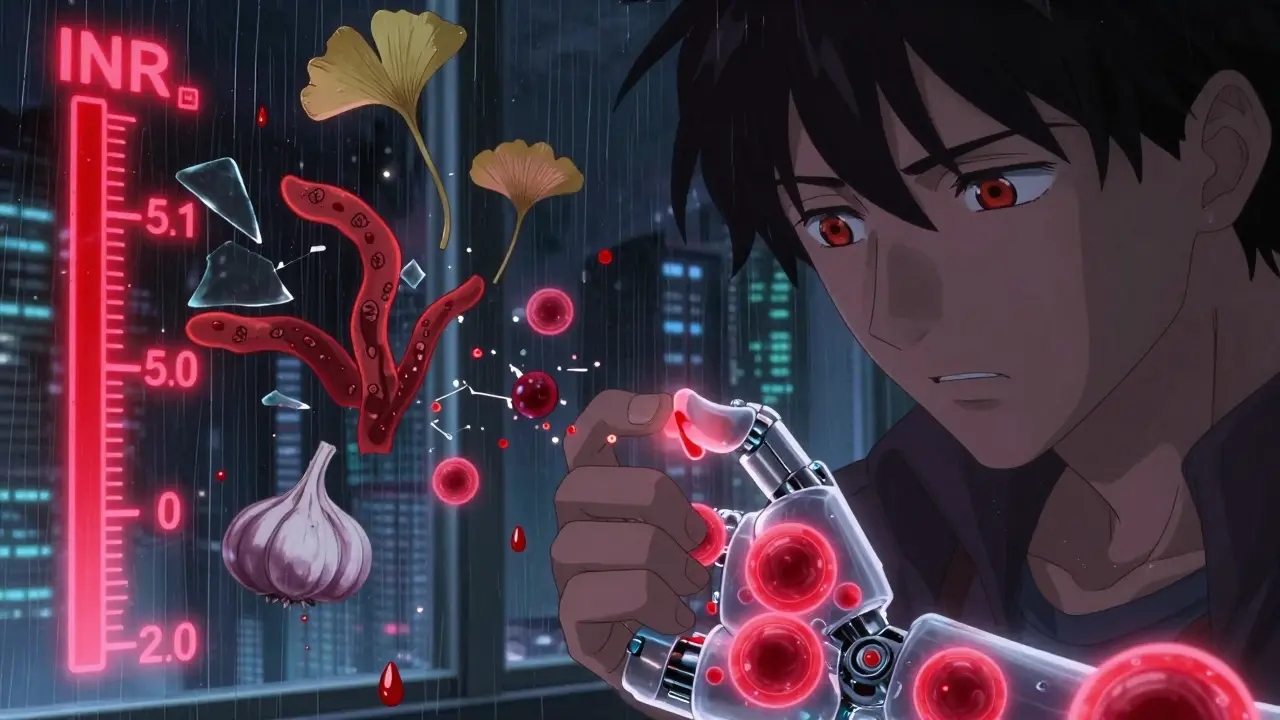
Your INR (International Normalized Ratio) is the number your doctor watches like a hawk. For most people on warfarin, the target range is 2.0 to 3.0. That’s the sweet spot: enough to prevent clots, but not so much that you bleed out from a minor cut. An INR above 4.0 puts you at serious risk. Above 5.0? That’s a medical emergency.One Reddit user, a 61-year-old woman managing menopause symptoms, reported her INR jumped from 2.8 to 5.1 after taking Dong Quai for two weeks. She didn’t notice bruising at first-just a little more fatigue. Then she woke up with a massive bruise on her thigh and noticed blood in her urine. She went to the ER. They reversed her anticoagulation with vitamin K and kept her overnight. Her doctor told her she’d been one fall away from a brain bleed.
This isn’t rare. HealthUnlocked forums tracked 23 documented cases between 2020 and 2023 where patients had unexplained INR spikes linked to Dong Quai. The average increase? 1.7 points. That’s enough to push someone from safe to dangerous in under a week.
It’s Not Just About the Herb-It’s About the Product
Here’s the kicker: not all Dong Quai supplements are the same. The U.S. Pharmacopeia tested 15 different brands in 2020 and found ferulic acid content varied by up to 8 times between products. One bottle might have enough to affect your INR. Another might be so weak it’s practically water. There’s no standardization. No FDA oversight. No way to know what you’re actually getting.And that’s why doctors don’t say, "Just take less." They say, "Don’t take it at all." Even if you think you’re being careful, the variability makes it impossible to predict. One batch could be fine. The next one, bought three months later, could send your INR through the roof.
Other Hidden Risks You Might Not Know About
Dong Quai doesn’t just mess with your blood. It also acts like estrogen in the body. Studies show it stimulates the growth of estrogen-sensitive breast cancer cells in lab settings. If you’ve had breast cancer-or have a family history-taking Dong Quai could be actively harmful. Memorial Sloan Kettering specifically flags this risk in their 2023 guidelines.And it doesn’t stop there. Dong Quai may also interfere with how your liver breaks down warfarin. Some lab studies suggest it inhibits CYP2C9 and CYP3A4 enzymes-the very enzymes responsible for clearing warfarin from your system. If that happens, warfarin sticks around longer, building up in your blood. Your INR climbs even if you haven’t changed your pill dose.
What the Experts Say
Dr. Edzard Ernst, former professor of complementary medicine at the University of Exeter, put it bluntly: "The theoretical risk is substantial enough to warrant avoidance." He’s not alone. The American Heart Association calls Dong Quai a "high-risk herb" for anticoagulated patients. Dr. Catherine Ulbricht from Massachusetts General Hospital says the antiplatelet effect can easily push INR from 2.5 to over 4.0-right into the danger zone.The American College of Cardiology’s 2023 guidelines list Dong Quai in the same category as ginkgo, garlic, and St. John’s wort: herbs with "established or probable interaction risk" that should be avoided entirely if you’re on warfarin.
What Should You Do?
If you’re on warfarin and taking Dong Quai-stop. Immediately. Don’t wait for your next appointment. Call your anticoagulation clinic or pharmacist. Get your INR checked within 3 to 5 days of quitting.If you’re thinking about starting it? Don’t. There’s no safe dose. No proven benefit that outweighs the risk. For menopause symptoms, there are safer alternatives: black cohosh (with your doctor’s approval), low-dose estrogen therapy if appropriate, or even cognitive behavioral therapy for hot flashes. None of those carry the same bleeding risk.
And if you’re a healthcare provider? Screen every patient on warfarin for herbal supplement use. Don’t assume they’ll tell you. A 2022 survey found 68% of warfarin users didn’t know Chinese herbs could interact with their medication. But 82% said they’d stop if they knew the risk.

What About Other Herbs?
Dong Quai isn’t alone. Ginkgo, garlic, ginger, fish oil, turmeric, and feverfew all carry similar warnings. If you’re on warfarin, assume any herbal supplement is a potential risk until proven otherwise. The American Society of Health-System Pharmacists recommends avoiding all of them unless you’re under direct supervision-and even then, only with frequent INR checks.The bottom line: supplements aren’t harmless. They’re not regulated like drugs. And when you’re on warfarin, your body is walking a tightrope. One wrong step-like adding Dong Quai-and you could fall.
What to Do If You’ve Already Taken It
If you’ve taken Dong Quai while on warfarin, even once:- Stop taking it immediately.
- Call your doctor or anticoagulation clinic. Don’t wait.
- Get an INR test within 3-5 days.
- Inform your pharmacist about the supplement use.
- Keep a written log of all supplements you take-including brand names and doses-for future reference.
Even if you feel fine, don’t assume you’re safe. Bleeding can be silent-internal, slow, and deadly. INR is the only way to know.
Why This Matters Now More Than Ever
The global Dong Quai market is growing-up nearly 10% since 2020. Sales in North America are rising fast. But so are the warnings. The European Medicines Agency now requires Dong Quai labels to include a clear warning about warfarin interactions, effective January 2025. The NIH is funding a major clinical trial to measure the exact interaction in humans, with results expected in late 2024.Until then, the safest choice is clear: if you’re on warfarin, leave Dong Quai on the shelf. Your blood-and your life-depend on it.
jeremy carroll
December 16, 2025 AT 15:08bro i took dong quai for like 3 weeks last year and didn’t think twice. my INR was fine until i started bleeding outta nowhere. ER visit, vitamin k, scared the hell outta me. now i just stick to tea and yoga. don’t be like me.
Alexis Wright
December 16, 2025 AT 21:04Let’s be real - this isn’t about ‘herbs.’ It’s about the FDA’s complete failure to regulate anything that isn’t patented. Dong Quai’s been used for millennia, but because Big Pharma can’t monetize it, they label it ‘dangerous’ to scare people into buying their overpriced, side-effect-laden synthetic junk. The real danger? Trusting a system that profits from your fear.
Natalie Koeber
December 17, 2025 AT 20:56did you know the FDA is secretly funded by pharmaceutical companies? they’re the ones pushing this ‘danger’ narrative so you’ll keep buying warfarin instead of natural remedies. dong quai’s been in chinese medicine for 2000 years - if it were truly dangerous, why are we only hearing about it now? 🤔
Rulich Pretorius
December 18, 2025 AT 18:44As someone who’s worked in rural clinics across South Africa, I’ve seen patients on warfarin take everything from neem to moringa without knowing the risks. The real issue isn’t the herb - it’s the lack of accessible education. If we could get clear, simple info into the hands of people who need it, we’d prevent so many ER visits. Knowledge is the real medicine here.
Thomas Anderson
December 20, 2025 AT 00:37my grandma took dong quai for cramps and never knew it could mess with her blood. she got a bruise the size of a grapefruit and thought it was just aging. never even told her doctor. please, if you’re on warfarin - tell your doc about every pill, tea, or powder you take. even the ‘harmless’ ones.
Dwayne hiers
December 21, 2025 AT 00:08From a pharmacokinetic standpoint, the CYP2C9 and CYP3A4 inhibition by osthole and ferulic acid derivatives in Dong Quai creates a non-linear, dose-dependent pharmacodynamic interaction with S-warfarin - the more potent enantiomer. This results in a prolonged half-life and elevated AUC, significantly increasing INR instability. The variability in botanical extracts compounds this exponentially. There is no safe threshold.
Jonny Moran
December 21, 2025 AT 07:26I’m from Jamaica - we use herbs for everything. But I learned the hard way: just because something’s natural doesn’t mean it’s safe with meds. My cousin ended up in ICU after mixing turmeric and warfarin. Now I tell everyone: if it’s not on your doctor’s approved list, don’t touch it. Your life isn’t worth the gamble.
Sarthak Jain
December 21, 2025 AT 12:14my aunt in delhi took dong quai for menopause and her INR spiked to 6.2. she didn’t even know it was a problem. doctors here don’t talk about herbal stuff - they assume you’re not taking it. if you’re on warfarin, always ask: ‘is this gonna mess with my blood?’ and if they say ‘probably not’ - walk out.
Sinéad Griffin
December 22, 2025 AT 01:39AMERICA IS BEING POISONED BY CHINESE HERBS AND BIG PHARMA’S LIES!! 🇺🇸💥 DON’T LET THEM CONTROL YOUR BODY! DONG QUAI IS PURE NATURE - THEY JUST WANT YOU DEPENDENT ON CHEMICALS!! 🚫💊 #STOPTHEFDA #NATURALHEALING
Edward Stevens
December 22, 2025 AT 12:44so let me get this straight - we’re supposed to trust doctors who prescribe warfarin (a rat poison, btw) but not trust a plant that’s been used since Confucius was a kid? 🤷♂️
Daniel Thompson
December 22, 2025 AT 16:34I’ve been on warfarin for 12 years. I’ve never taken any supplement. I don’t need to. I follow my diet, I track my INR, and I don’t gamble with my health. If you’re not doing the same, you’re not being responsible - you’re being reckless.
Daniel Wevik
December 22, 2025 AT 22:10Here’s what nobody says: the real problem isn’t Dong Quai. It’s that we treat medicine like a menu. You don’t add extra seasoning to your chemotherapy. You don’t mix supplements with insulin. Why treat warfarin any differently? It’s not a suggestion - it’s a precision tool. Treat it like one.
Rich Robertson
December 23, 2025 AT 11:46I grew up in Vietnam - our grandmas used dong quai tea for everything. But here in the U.S., I learned the hard way that context matters. Same herb, different bodies, different meds. I stopped taking it after my doctor showed me the INR graph. No drama. Just respect for the science. Your body’s not a lab experiment - treat it like the temple it is.
Wade Mercer
December 24, 2025 AT 12:23People who take supplements while on warfarin are just asking for death. This isn’t ‘natural healing’ - it’s self-sabotage. If you can’t follow basic medical advice, don’t be surprised when your body gives up. You’re not a martyr. You’re just careless.