

Dofetilide-Cimetidine Interaction Checker
Check Your Medication Combination
This tool helps you determine if your heart rhythm medication and heartburn treatment are safe to take together. The interaction between dofetilide (Tikosyn) and cimetidine (Tagamet) can cause life-threatening heart rhythms.
Please check your medication combination to see if it's safe.
Imagine taking a pill for heartburn, thinking it’s harmless-only to trigger a life-threatening heart rhythm days later. This isn’t a hypothetical scenario. It’s a documented, preventable danger between two common medications: dofetilide and cimetidine. While dofetilide helps reset abnormal heart rhythms, cimetidine treats stomach acid. Together, they create a perfect storm that can send patients into cardiac arrest. This isn’t a rare footnote in a medical textbook. It’s a high-risk interaction that kills-and it’s still happening today.
How Dofetilide Works (And Why It’s So Dangerous)
Dofetilide, sold under the brand name Tikosyn, is a Class III antiarrhythmic drug approved by the FDA in 1999. It’s used to restore normal heart rhythm in people with atrial fibrillation or atrial flutter. But unlike many heart medications, dofetilide has an extremely narrow window between effectiveness and toxicity. Too little? It doesn’t work. Too much? It can trigger torsades de pointes, a violent, chaotic heart rhythm that often leads to sudden death.
What makes dofetilide so tricky is how it leaves the body. About 80% of the drug is excreted unchanged through the kidneys via a specific cation transport system. This system is precise, sensitive, and easily blocked. Even a small disruption can cause dofetilide to build up in the bloodstream. And that’s where cimetidine comes in.
Cimetidine: The Silent Saboteur
Cimetidine, sold as Tagamet, is an H2 blocker used for heartburn and ulcers. It was one of the first acid-reducing drugs on the market, approved in 1977. But unlike newer H2 blockers like famotidine (Pepcid) or ranitidine (Zantac), cimetidine has a dark side when paired with dofetilide. It doesn’t just reduce stomach acid-it shuts down the kidney’s ability to clear dofetilide.
Studies show cimetidine can increase dofetilide blood levels by 50% to 100% within just 24 hours. That’s not a minor bump. That’s a doubling of exposure. The FDA’s own data from clinical trials (Study DOF-30001) confirmed this. In healthy volunteers, cimetidine raised dofetilide concentrations so much that QT intervals-measured on an ECG-prolonged dramatically. And QT prolongation isn’t just a number on a monitor. It’s the electrical signal that tells your heart when to reset. When it’s too long, your heart can misfire.
The Real Risk: Torsades de Pointes
When dofetilide builds up, the risk of torsades de pointes jumps from 3-5% (with dofetilide alone) to 12-18% when cimetidine is added. That’s a fourfold increase. And it doesn’t take long. Case reports show patients developing life-threatening arrhythmias within 48-72 hours of starting cimetidine.
A 72-year-old man in a 2020 case report was on stable dofetilide for atrial fibrillation. He started cimetidine for heartburn. Three days later, he went into torsades de pointes. He needed emergency cardioversion and ICU care. Another patient, a 65-year-old woman, took a single 300 mg dose of cimetidine for sudden heartburn and collapsed with polymorphic ventricular tachycardia. She survived-but barely.
The FDA’s Adverse Event Reporting System recorded 87 cases of QT prolongation and 23 cases of torsades de pointes directly tied to this combination between 2010 and 2022. That’s not noise. That’s a pattern. And cardiologists know it. According to a 2022 survey of 47 academic hospitals, 12-15% of unexpected torsades cases in dofetilide patients were traced back to unrecognized cimetidine use.
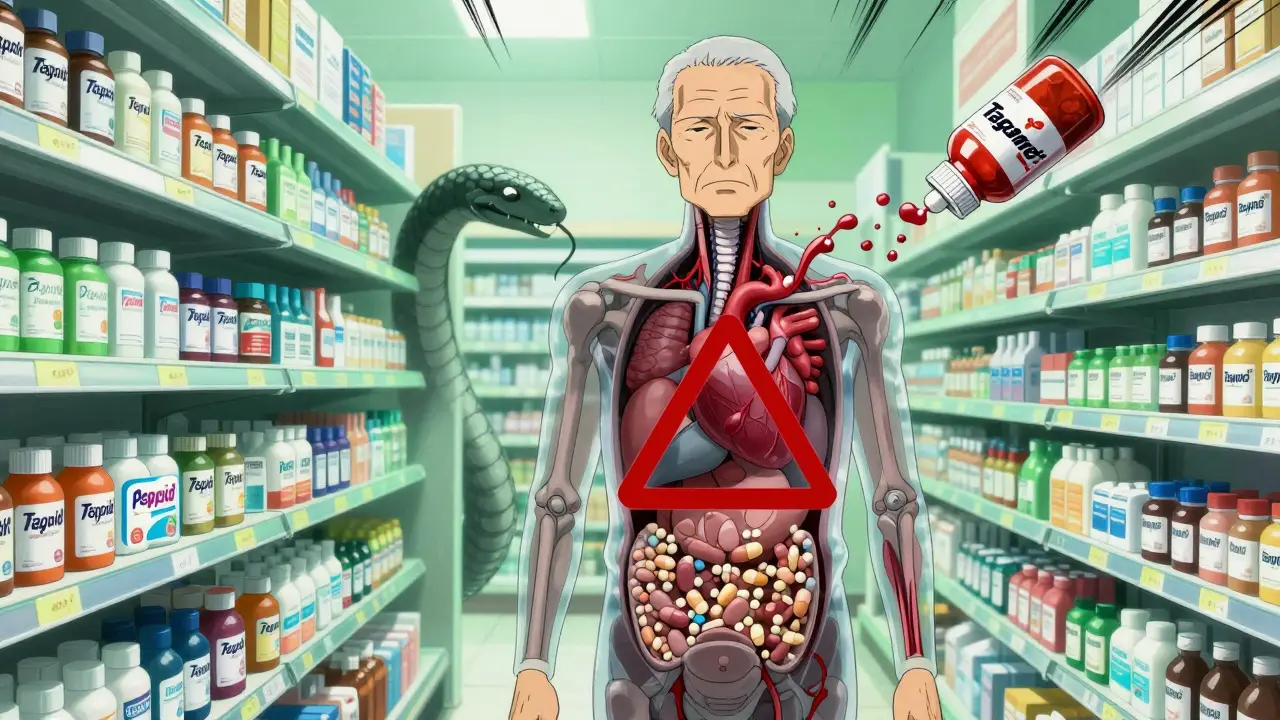
Why Famotidine Is Safe (And Cimetidine Isn’t)
This is where things get critical. Not all acid reducers are equal. Famotidine (Pepcid), ranitidine (Zantac), and proton pump inhibitors like omeprazole do not interfere with dofetilide’s kidney clearance. Studies (DOF-30002) show no significant change in dofetilide levels when these are used together.
Cimetidine is unique because it blocks the cation transport system in the kidneys. Other H2 blockers don’t. That’s why medical guidelines are crystal clear: cimetidine is contraindicated with dofetilide. The American College of Cardiology, the European Heart Rhythm Association, and the American Heart Association all list this combination as “rarely appropriate” or “contraindicated.”
Dr. Jonathan Piccini of Duke University put it bluntly: “This is one of the clearest contraindications in clinical cardiology.” Dr. Bruce Wilkoff from Cleveland Clinic called its continued use “a systems failure.”
What Should You Do? A Practical Guide
If you’re taking dofetilide, here’s what you need to know:
- Never take cimetidine. Not even once. Not for a few days. Not for a bad stomach. It’s not worth the risk.
- If you need acid control, use famotidine (up to 40 mg twice daily) or a PPI like omeprazole 20 mg daily. Both are safe.
- Before starting dofetilide, your doctor must check your QT interval. If it’s over 440 ms (or 500 ms with conduction issues), you shouldn’t take it at all.
- Your potassium level must be between 4.0-5.0 mmol/L. Low potassium makes QT prolongation worse.
- If you’ve taken cimetidine recently, wait at least 10 days before starting dofetilide. That’s five half-lives of cimetidine. Don’t guess-wait.
Many hospitals now have electronic alerts built into their systems. Epic and Cerner block prescriptions that pair these two drugs. If a doctor tries to order them together, the system forces a cardiologist to override it. In 2015, 8.7% of patients on dofetilide were accidentally prescribed cimetidine. By 2022, that dropped to 1.2%-thanks to technology.

Why This Matters Beyond the Lab
This isn’t just about one drug pair. It’s about how polypharmacy kills. The average person with atrial fibrillation takes nearly seven prescription drugs. Each one adds risk. Dofetilide is already high-risk. Cimetidine, though widely available over the counter, is one of the most dangerous companions it can have.
The American Geriatrics Society’s 2023 Beers Criteria lists this combination as one of the “most inappropriate medication pairs for older adults.” And that’s not surprising. Older patients often have reduced kidney function, take more meds, and are more likely to use OTC heartburn remedies. They’re the most vulnerable.
Each avoided interaction saves about $47,500 in hospital costs-emergency care, ICU stays, defibrillators, long-term monitoring. But money isn’t the point. Lives are.
The Bottom Line
Dofetilide and cimetidine should never be used together. Not even for a day. Not even if you think it’s “just a little.” The science is clear. The warnings are loud. The deaths are real.
If you’re on dofetilide, check your medicine cabinet. If you see Tagamet, throw it out. Switch to Pepcid or omeprazole. Tell your pharmacist. Tell your doctor. Ask for a full medication review.
This interaction is preventable. But only if you know it’s there.
Can I take cimetidine if I’m on dofetilide, even for a few days?
No. Even short-term use of cimetidine-just 48 hours-can trigger life-threatening arrhythmias in patients taking dofetilide. The interaction is rapid, predictable, and dangerous. There is no safe duration. Always avoid cimetidine entirely if you’re on dofetilide.
Is famotidine (Pepcid) safe with dofetilide?
Yes. Unlike cimetidine, famotidine does not inhibit the kidney’s cation transport system and does not raise dofetilide blood levels. It is the preferred H2 blocker for patients on dofetilide. Doses up to 40 mg twice daily are considered safe. Always confirm with your doctor, but famotidine is the standard replacement.
What if I accidentally took cimetidine while on dofetilide?
Contact your doctor immediately. Do not wait for symptoms. You may need an ECG to check your QT interval and blood tests to monitor potassium. If your QT interval is prolonged or you feel dizzy, faint, or have palpitations, go to the ER. Torsades de pointes can develop within hours. Do not stop dofetilide on your own-this requires medical supervision.
Does cimetidine affect other antiarrhythmics the same way?
No. The interaction is specific to dofetilide because of how it’s cleared by the kidneys. Other antiarrhythmics like amiodarone or sotalol are cleared differently and don’t share this exact mechanism. But cimetidine can still interact with other drugs-especially those metabolized by the liver or cleared renally. Always check interactions for every medication you take.
Why isn’t cimetidine banned if it’s so dangerous?
Cimetidine is still available because it’s effective for acid-related conditions and has been used safely for decades in people not taking dofetilide or other high-risk drugs. The danger is specific to this combination. Instead of banning cimetidine, the medical system now uses alerts, education, and guidelines to prevent this interaction. The focus is on smart prescribing, not removal.
Can I switch from dofetilide to another drug to avoid this risk?
Possibly. Drugs like amiodarone, dronedarone, or vernakalant may be alternatives, but they each have their own risks-liver toxicity, lung damage, or limited effectiveness. Switching isn’t automatic. It requires careful evaluation by a cardiologist. The goal isn’t just to avoid cimetidine-it’s to find the safest overall rhythm control strategy for your specific condition.
Erica Banatao Darilag
February 13, 2026 AT 20:24Just wanted to say thank you for writing this. I work in pharmacy and see this mix-up way too often. Elderly patients grab Tagamet because it’s cheap and they remember it from the 90s. No one thinks twice. But the data doesn’t lie - one dose can be enough. I’ve seen two patients in the last year end up in the ICU over this. It’s terrifying how simple it is to prevent.
Charlotte Dacre
February 13, 2026 AT 23:56So let me get this straight - we have a drug that can kill you if you take it with a $5 over-the-counter heartburn pill… and people still buy it like it’s a magic potion? Cimetidine is basically the villain in a bad medical thriller. The FDA’s been screaming about this since 2001. Someone’s got to sue the manufacturers for not putting a skull-and-crossbones sticker on it.
Virginia Kimball
February 15, 2026 AT 20:22OMG this is wild. I had no idea cimetidine was such a sneaky little monster. My grandma’s been on dofetilide for two years and I just found a half-used bottle of Tagamet in her cabinet. We threw it out and switched to Pepcid - she’s fine now. But seriously, why isn’t this on every OTC box? Like, imagine if every painkiller had a neon sign saying ‘DO NOT TAKE WITH ANTICOAGULANTS’ - we’d save so many lives. Let’s make this common knowledge. Share this post. Tag your pharmacist. Tell your aunt. This isn’t rocket science - it’s survival.
Kaye Alcaraz
February 16, 2026 AT 10:31While the clinical evidence is unequivocal, the systemic failure remains unaddressed. The absence of mandatory labeling on over-the-counter formulations, coupled with insufficient patient education, perpetuates preventable morbidity. It is imperative that regulatory bodies enforce clear contraindication alerts at point-of-sale. Furthermore, electronic health record integration, while improved, is not universal. Standardization of pharmacovigilance protocols across all care settings is not optional - it is ethical.
Sarah Barrett
February 16, 2026 AT 13:29Interesting how the most dangerous drug interactions are the ones no one talks about. Like, everyone knows about warfarin and broccoli, but nobody warns you about Tagamet and Tikosyn. I’ve been on dofetilide for six months. My cardiologist never mentioned this. I only found out because I read this post. That’s terrifying. Shouldn’t this be part of the standard counseling? I’m not mad - just stunned.
Mike Hammer
February 17, 2026 AT 09:44Bro i just took cimetidine last week for a stomach bug and im on dofetilide. should i panic? i feel fine. maybe im fine? i mean its been 4 days? idk. maybe i should go to the er? or is that overreacting? i just dont wanna die but also dont wanna waste my time. help.
Joe Grushkin
February 19, 2026 AT 01:11Let’s be real - this isn’t a medical crisis. It’s a failure of intelligence. If you can’t read a medication label or understand that OTC doesn’t mean harmless, then you shouldn’t be allowed to manage your own prescriptions. The fact that this interaction even exists in the wild is proof that society has devolved into a parade of ignorance. Wake up. Read the insert. Or don’t. But don’t blame the system when your heart stops.
Kapil Verma
February 20, 2026 AT 23:24Why does America keep making such stupid rules? In India, we have no such problem. We know cimetidine is dangerous. We don’t need fancy alerts or EHR systems. We just teach people. Your doctors here are lazy. Your patients are careless. You have all the technology, yet you still die from simple mistakes. We don’t have 87 cases - we have zero. Because we respect the science. You need discipline, not software.
Michael Page
February 22, 2026 AT 22:26It’s ironic that the body’s most precise mechanisms - the renal cation transporters - are undone by the most rudimentary of interventions: a molecule that blocks a channel not because it’s potent, but because it’s structurally clumsy. We treat drugs like Lego blocks, stacking them without considering the underlying architecture of homeostasis. This isn’t a drug interaction. It’s a metaphysical oversight. We’ve outsourced wisdom to algorithms and forgotten that biology doesn’t care about your convenience.
Mandeep Singh
February 23, 2026 AT 01:47You think this is bad? Wait till you hear about how people in the US take ibuprofen with lisinopril and then wonder why their kidneys fail. Or how they mix statins with grapefruit juice like it’s a smoothie. This is just one of a hundred silent killers. And you know what? The pharmaceutical companies don’t care. They make billions off the confusion. They don’t want you to know. They want you to keep buying. This post? It’s not just information - it’s rebellion. Read it again. Share it. Fight back. Don’t let them turn your body into a profit margin.