

MAOI Safety Calculator
When Can You Safely Take Cough Suppressants?
This tool calculates the minimum safe waiting period after your last MAOI dose before taking dextromethorphan (DM) containing products.
If you're taking an MAOI for depression or Parkinson’s, and you reach for a bottle of Robitussin or Delsym for a bad cough, you could be putting your life at risk. This isn’t a hypothetical warning-it’s a well-documented, deadly interaction that happens more often than you think. Dextromethorphan, the active ingredient in dozens of over-the-counter cough syrups and pills, can trigger a dangerous surge in serotonin when mixed with MAOIs. The result? Serotonin syndrome-a condition that can turn deadly within hours.
What Exactly Is Serotonin Syndrome?
Serotonin syndrome isn’t just a bad reaction. It’s a medical emergency. When too much serotonin builds up in your brain and nervous system, your body goes into overdrive. Symptoms start with mild shaking, sweating, and a rapid heartbeat. But they can quickly escalate to high fever (104°F or higher), muscle rigidity, confusion, seizures, and even loss of consciousness. In severe cases, organ failure and death can follow. According to a 2022 review in the PMC journal, between 2% and 12% of severe serotonin syndrome cases are fatal. Many patients don’t survive long enough for the drugs to clear their system.The problem with dextromethorphan is that it doesn’t just suppress coughs-it also blocks serotonin reuptake. That means it keeps serotonin hanging around in your brain longer. MAOIs do the same thing, but in a different way: they stop your body from breaking down serotonin at all. When you combine them, serotonin levels skyrocket. There’s no safe middle ground. Even a single dose of dextromethorphan while on an MAOI can trigger symptoms.
Which MAOIs Are Dangerous With Dextromethorphan?
It’s not just one or two drugs. Any MAOI carries this risk. That includes:- Phenelzine (Nardil)
- Tranylcypromine (Parnate)
- Rasagiline (Azilect)
- Selegiline (Zelapar, Emsam)
- Isocarboxazid (Marplan)
Even the newer, reversible MAOIs like moclobemide (not yet approved in the U.S.) carry some risk, though fewer cases have been reported. The danger is highest with older, irreversible MAOIs-those that permanently disable the enzyme that breaks down serotonin. These are the ones most commonly prescribed for treatment-resistant depression and Parkinson’s disease.
And here’s the catch: you don’t have to be on the MAOI right now to be at risk. The drug stays active in your system for weeks. The FDA, the Therapeutic Goods Administration of Australia, and the National Library of Medicine all agree: you must wait at least 14 days after your last dose of an MAOI before taking dextromethorphan. Some experts recommend waiting 21 days, especially if you were on a high dose or long-acting version.
Why Do So Many People Get This Wrong?
You’d think a warning this serious would be impossible to miss. But it’s not. A 2019 survey by the American Society of Health-System Pharmacists found that 78% of patients on MAOIs didn’t know that common cough medicines contained dextromethorphan. They read “cough suppressant” and assumed it was safe. They didn’t check the ingredients. They didn’t ask their pharmacist.Even the labels don’t always help. A 2021 analysis by the Institute for Safe Medication Practices found that only 38% of dextromethorphan products prominently display the MAOI warning. Some put it in tiny print on the back. Others bury it under a list of inactive ingredients. Patients miss it. Pharmacists miss it. Even doctors miss it-unless they specifically ask.
Real-world cases prove how easy it is to slip through the cracks. One Reddit user on r/MAOI described being hospitalized after taking a nighttime cold syrup while on selegiline. They developed a 104°F fever, muscle rigidity, and extreme confusion. Another patient on PatientsLikeMe took Parnate and a cough drop, then couldn’t speak clearly within four hours. ER doctors told them they were lucky to survive.

What About Other Cough Medicines?
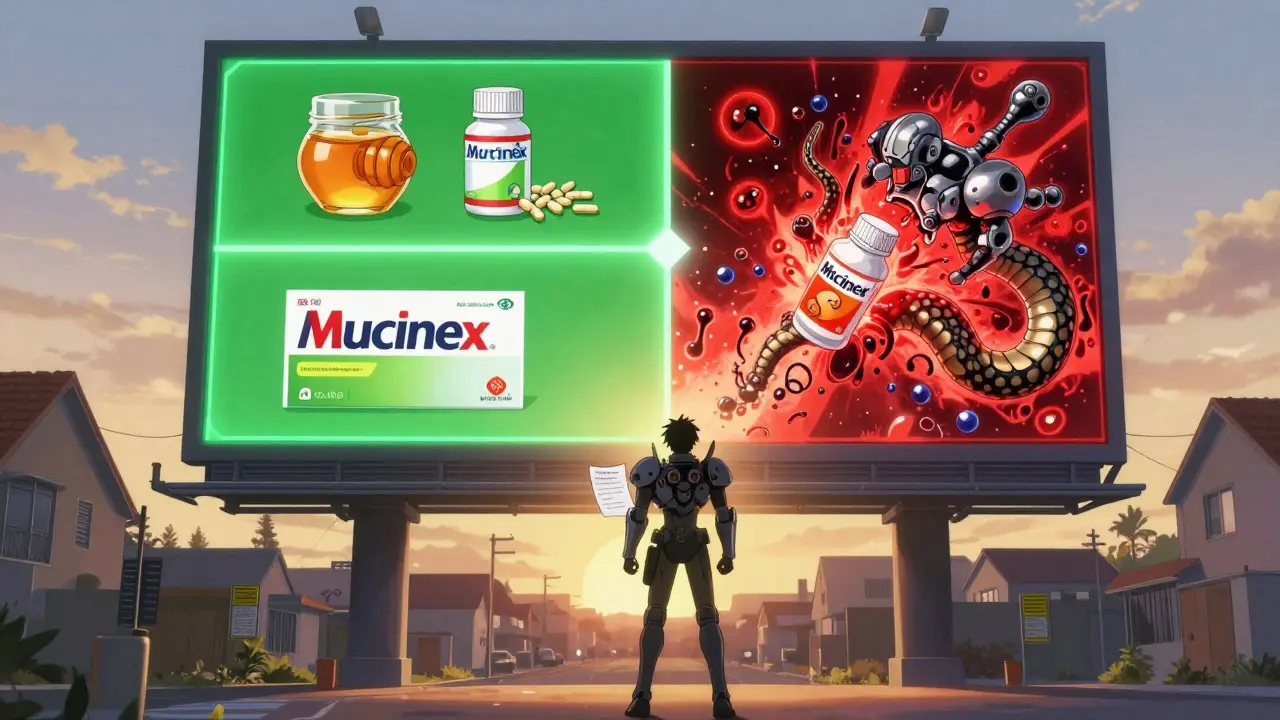
Not all cough medicines are dangerous. If you’re on an MAOI, you can safely use:- Guaifenesin (Mucinex)-this thins mucus, doesn’t affect serotonin
- Honey-a natural cough suppressant shown to be as effective as dextromethorphan in some studies
- Steam inhalation or saline nasal sprays
But even honey isn’t risk-free. Some honey products contain trace amounts of tyramine, which can interact with MAOIs and cause high blood pressure. Stick to pasteurized, plain honey. Avoid raw, unfiltered, or flavored varieties unless you’re certain of the source.
Also avoid other OTC cough products that contain pseudoephedrine or phenylephrine. While they don’t cause serotonin syndrome, they can spike blood pressure when combined with MAOIs. The same goes for nasal decongestants. Always read the full ingredient list-not just the brand name.
What Should You Do If You’ve Taken Both?
If you’ve accidentally taken dextromethorphan while on an MAOI, don’t wait. Watch for these signs:- Shaking or tremors
- Fast heartbeat or high blood pressure
- High fever (102°F or above)
- Muscle stiffness or twitching
- Confusion, agitation, or hallucinations
- Nausea, vomiting, or diarrhea
If you have two or more of these symptoms, go to the ER immediately. Don’t call your doctor first. Don’t wait to see if it gets better. Serotonin syndrome can kill faster than you think. Treatment involves stopping both drugs, cooling the body, and sometimes giving medications like cyproheptadine to block serotonin. In severe cases, patients need ICU care and sedation.
There’s no home remedy. No tea. No rest. Only medical intervention can reverse the damage.
How to Stay Safe
If you’re on an MAOI, here’s your action plan:- Make a list of every medication you take-prescription, OTC, herbal, or supplement.
- Check every cough, cold, or flu product for “dextromethorphan” or “DM.”
- Ask your pharmacist: “Is this safe with MAOIs?” Don’t assume they know-ask specifically.
- Wait at least 14 days after your last MAOI dose before using any cough suppressant.
- Keep a printed list of dangerous drugs in your wallet or phone. Show it to any new provider.
Pharmacists who counsel MAOI patients on OTC risks reduce dangerous interactions by 67%, according to a 2021 study. That’s not a small number. It’s life-saving. But you can’t rely on them to catch everything. You have to be your own advocate.
What’s Changing in 2026?
The FDA proposed stronger labeling for dextromethorphan products in 2022, with new requirements expected to roll out by late 2024. That means bigger, bolder warnings on packaging. Some manufacturers are already updating labels ahead of the deadline.The European Medicines Agency now requires all MAOI prescriptions to include a printed guide listing dextromethorphan-containing brands by name. In the U.S., organizations like the National Alliance on Mental Illness are rolling out standardized patient education materials in early 2025 to fix the gap-only 43% of patients get proper counseling when starting MAOI therapy.
And as MAOI use rises-up 22% since 2020 for treatment-resistant depression-the risk isn’t going away. It’s growing. More people are using these powerful drugs. More people are reaching for cough medicine without realizing the danger.
This isn’t about fear. It’s about awareness. You don’t have to avoid all cold remedies. You just need to know what’s safe-and what could kill you.
Philip House
January 22, 2026 AT 09:24Look, I don’t care if you’re on Nardil or Parnate or some fancy new Azilect - if you’re dumb enough to grab Robitussin without reading the label, you deserve what you get. I’ve seen guys in the ER with 105°F fevers because they thought ‘cough suppressant’ meant ‘harmless.’ You’re not special. Your cough isn’t that bad. Stop being lazy and use honey. Or better yet - stop taking MAOIs if you can’t handle basic safety.
Ryan Riesterer
January 22, 2026 AT 23:09The pharmacokinetic interaction between MAOIs and dextromethorphan is well-characterized in the literature: irreversible monoamine oxidase-A inhibition combined with serotonin reuptake inhibition creates a synergistic serotonergic load exceeding the threshold for clinical serotonin syndrome. The 14-day washout period is conservative; given the half-life of phenelzine’s hydrazine metabolites, 21 days is pharmacologically prudent. Labeling inadequacies reflect regulatory lag, not negligence - but the burden of verification remains on the prescriber and patient.
Liberty C
January 23, 2026 AT 23:59Oh please. You think people don’t know this because they’re stupid? No. They know. They just don’t care. The pharmaceutical industry doesn’t want you to know how dangerous these drugs are - they’re making billions off your ignorance. And now they’re ‘updating labels’ like that fixes anything. Wake up. The FDA’s been asleep at the wheel since the ’90s. You think a bigger font on a bottle is going to save someone who’s been told by their ‘doctor’ that ‘it’s fine, just take one pill’? Please. We’re all just lab rats in a corporate experiment.
shivani acharya
January 24, 2026 AT 23:11Okay so let me get this straight - you’re telling me that my grandma who takes selegiline for Parkinson’s and just wants to sleep through the night without coughing up a lung is gonna die because she took a Delsym? And you think the answer is ‘just use honey’? Honey? In 2025? That’s what you’re recommending? I live in a country where they sell cough syrup with dextromethorphan next to the toothpaste and no one reads the tiny print - and now you want me to believe that the system is gonna fix itself because ‘some manufacturers are updating labels’? LOL. I’m not even mad. I’m just disappointed. We’re all gonna die of a cough because capitalism doesn’t care if you live or die as long as you keep buying stuff.
Margaret Khaemba
January 26, 2026 AT 12:56I’m from Kenya and we don’t have dextromethorphan in our OTC meds - we use ginger tea, steam, and honey. But I’ve had friends in the US who’ve been on MAOIs and didn’t know the risks. I think the real issue is access to education. Not everyone has a pharmacist who takes time to explain. Maybe pharmacies should have mandatory QR codes on these products that link to a 30-second video in plain language. And maybe doctors should give printed cards when prescribing MAOIs - like the ones they give for warfarin. It’s not rocket science. It’s basic patient safety.
Malik Ronquillo
January 26, 2026 AT 15:11Man I just took Delsym last week and I’m on Zelapar. I’m still here. So maybe it’s not that bad? Like I get the warnings but c’mon - how many people actually die from this? I’m not scared. I’m just annoyed that everyone’s acting like it’s the end of the world. I’ve got a cough, I’ve got a pill, I’m taking it. If I die? Well. At least I didn’t die bored.
Alec Amiri
January 27, 2026 AT 05:14LOL you think this is rare? I know a guy who took NyQuil while on Nardil and ended up in a coma for 3 days. He woke up screaming about angels. His wife said he kept saying ‘the syrup was talking to me.’ That’s not serotonin syndrome. That’s a spiritual awakening. But he’s alive. So maybe the real danger is the fear? Maybe we’re all just scared of cough medicine because we’re scared of dying? I don’t know. I just know I’m not taking honey. Honey is for bees.
Lana Kabulova
January 28, 2026 AT 03:04Wait - so if I’m on MAOIs and I’ve been off them for 15 days, and I take one teaspoon of cough syrup - is that safe? What if I’m 72 and I’ve been on selegiline for 8 years and my liver is fried? Do I wait 21 days? Or 30? And what about if I’m on a patch? Or if I took a single 10mg dose of rasagiline last week? There’s no clarity. No standard. No guidance. Just a bunch of doctors saying ‘it depends’ and pharmacists shrugging. This isn’t safety. This is a gamble. And I’m tired of being the one holding the dice.