
When you can hear people talking but everything sounds muffled-like they’re speaking through a wall-that’s often a sign of conductive hearing loss. It’s not that your brain can’t process sound; it’s that sound isn’t getting through your outer or middle ear properly. Unlike sensorineural hearing loss, which involves nerve damage, conductive hearing loss is usually caused by physical blockages or structural issues in the middle ear. The good news? Many cases can be fixed with surgery.
What Exactly Is Conductive Hearing Loss?
Conductive hearing loss happens when sound waves can’t move efficiently from the outer ear to the inner ear. Think of it like a clogged pipe: the water (sound) is there, but it can’t flow. The problem lies in the ear canal, eardrum, or the tiny bones in the middle ear-the malleus, incus, and stapes. These bones are meant to vibrate and pass sound to the cochlea. If they’re stiff, broken, or blocked, hearing drops. People with this condition often struggle with soft sounds. Loud noises might seem clearer, but still distorted. It’s common in kids with ear infections and adults with earwax buildup, but it can also stem from more serious structural problems. Unlike sudden sensorineural hearing loss, which is a medical emergency, conductive loss usually develops slowly. But if it comes on fast-like after a head injury or loud explosion-it needs immediate attention.Common Middle Ear Problems That Cause Hearing Loss
Not all conductive hearing loss is the same. The cause determines the treatment. Here are the most frequent culprits:- Otitis media with effusion (glue ear): Fluid builds up behind the eardrum without infection. This is the most common cause of hearing loss in children. Up to 80% of kids have it by age 3. The fluid dampens vibrations, making voices sound distant.
- Cholesteatoma: A noncancerous skin cyst grows in the middle ear. It doesn’t sound dangerous, but it eats away at bone. Left untreated, it can destroy the ossicles, damage the inner ear, or even cause brain infections. Surgery is the only cure.
- Otosclerosis: A genetic condition where the stapes bone fuses to the inner ear wall. It’s progressive-often starting in young adults-and causes gradual hearing loss, especially in low frequencies. Women are more likely to develop it, especially during pregnancy.
- Tympanic membrane perforation: A hole in the eardrum from trauma, infection, or loud noise. About 15-20% of adult conductive hearing loss cases come from this. Many small holes heal on their own, but larger ones need repair.
- Aural atresia: A birth defect where the ear canal doesn’t form. It affects about 1 in 10,000 babies and often comes with malformed middle ear bones. Without intervention, hearing is severely limited.
How Is It Diagnosed?
You can’t diagnose this with a simple hearing test at a pharmacy. Proper diagnosis needs an audiologist and specialized tools. First, an ENT doctor looks inside the ear with an otoscope. They check for wax, fluid, or signs of infection. Then comes the key test: audiometry. Air conduction (sound through headphones) and bone conduction (a vibrator on the skull) are compared. If air conduction is worse than bone conduction, you’ve got an air-bone gap-classic conductive loss. The gap can range from 15 to 60 decibels, depending on severity. Tympanometry measures how the eardrum moves. A flat line (Type B) means fluid is trapped behind it-common in glue ear. A high-pressure reading might suggest a stiff ossicle. For complex cases, a high-resolution CT scan of the temporal bone shows bone structure in detail. It costs $800-$1,200 out-of-pocket in the U.S., but it’s often necessary before surgery.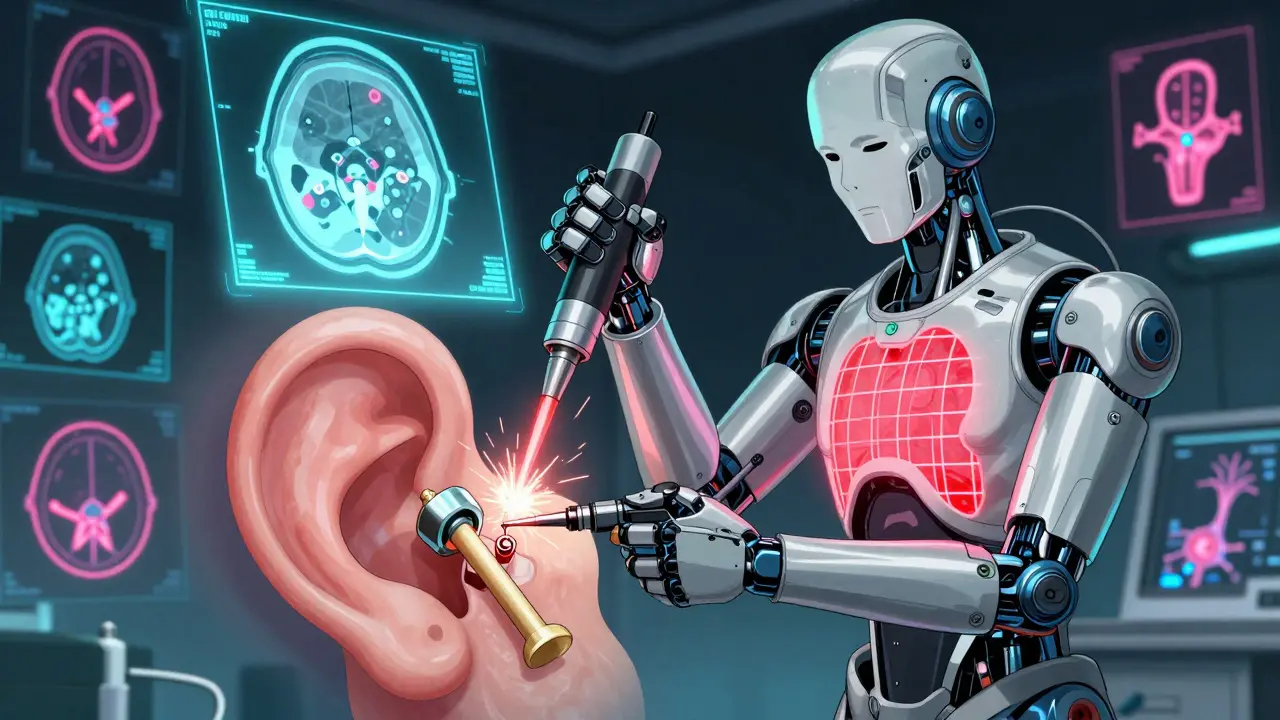
Surgical Options and Success Rates
Surgery isn’t always needed. About 65% of pediatric cases resolve with antibiotics or observation. But when hearing loss hits 25-30 dB and lasts more than 3-4 months, surgery becomes the best option.Tympanoplasty for Perforated Eardrums
This is the go-to fix for eardrum holes. Surgeons take a graft-usually from the patient’s own tissue, like temporalis fascia or cartilage-and patch the hole. Success rates? 85-95% for small perforations, 70-85% for larger ones. Recovery takes 6-8 weeks. Patients must avoid water, flying, and heavy lifting. New bioengineered grafts made from extracellular matrix are showing even better results-92% take rate versus 85% for traditional methods.Stapedectomy or Stapedotomy for Otosclerosis
For otosclerosis, the stapes bone is replaced. In a stapedotomy, a tiny hole is drilled into the stapes and a prosthetic piston is inserted. Lasers are now used in over 90% of cases, cutting complication rates from 15% to under 2%. Hearing improves dramatically: 80-90% of patients close their air-bone gap to within 10 dB. Many report hearing whispers for the first time. Side effects like temporary dizziness or altered taste are rare but possible.Myringotomy with Tubes for Glue Ear
In kids, doctors make a small cut in the eardrum and insert a tiny tube. This lets fluid drain and air flow in. About 667,000 of these procedures are done each year in the U.S. Most kids stop getting ear infections within weeks. Around 75% of cases resolve in 3 months. Some kids need repeat tubes, and 18% still get drainage that needs antibiotics.Canalplasty for Aural Atresia
This complex surgery rebuilds the ear canal and sometimes the middle ear bones. It’s often done in stages. Success? About 60-70% of patients gain functional hearing. But because the anatomy is so abnormal, multiple surgeries are common. Outcomes are better with 3D-printed prostheses tailored to the patient’s unique structure-currently in clinical trials with 94% improvement rates.Cholesteatoma Removal
This isn’t about improving hearing-it’s about survival. The cyst destroys bone. Surgery removes all the abnormal tissue, sometimes requiring mastoidectomy. Hearing restoration is a bonus, not the goal. Recovery takes 4-6 weeks. Patients often report longer healing times than expected, and 27% notice changes in sound quality after reconstruction.What to Expect After Surgery
Recovery isn’t instant. Most patients need 6-8 weeks before returning to normal activity. Water exposure is a big no-no swimming, showering without ear protection, or diving. Pressure changes (flying, scuba) must be avoided for at least 8 weeks. Some people experience temporary dizziness, tinnitus, or altered taste. These usually fade, but in rare cases, they persist. Patient satisfaction is high. On Mass Eye and Ear’s platform, 87% of stapedectomy patients reported major improvements. Parents of kids with tubes report 92% satisfaction. But it’s not perfect. About 12% of adults deal with lingering side effects. Realistic expectations matter.
What’s New in Middle Ear Surgery?
Technology is changing outcomes. Intraoperative navigation systems-like GPS for the ear-are now used in 78% of ENT practices. They improve precision by 35%. Endoscopic surgery, done through the ear canal without external incisions, is growing fast. By 2028, it’s expected to be standard for 60% of cases, cutting recovery time in half. 3D-printed ossicular prostheses are the next frontier. Instead of one-size-fits-all implants, surgeons can now print custom bones based on CT scans. Early results show 94% hearing improvement-better than traditional prostheses.When to Consider Surgery
Not every case needs it. If you or your child has fluid behind the eardrum, try observation or antibiotics first. But if hearing doesn’t improve after 3-4 months, or if you have cholesteatoma, bone erosion, or a large eardrum hole, surgery is the right path. Don’t wait. Prolonged hearing loss can affect speech development in kids and social isolation in adults. The global market for middle ear surgery devices is growing fast-projected to hit $1.8 billion by 2027. That’s because more people are getting diagnosed, and newer techniques are making surgery safer and more effective than ever.Can conductive hearing loss be fixed without surgery?
Yes, in many cases. Earwax removal, antibiotics for infections, or observation for fluid in children often resolve the issue. About 65% of pediatric cases improve without surgery. But if the cause is structural-like otosclerosis, cholesteatoma, or a large eardrum hole-surgery is usually the only way to restore hearing.
How long does recovery take after middle ear surgery?
Recovery varies by procedure. Tympanoplasty and stapedotomy usually require 6-8 weeks of activity restrictions. Patients must avoid water, flying, and heavy lifting. Cholesteatoma surgery often takes longer-4 to 6 weeks before returning to normal routines. Full healing can take up to 3 months.
Is surgery for otosclerosis safe?
Modern stapedotomy with laser technology is very safe. Complication rates have dropped from 15% in the 1980s to under 2% today. The most common side effects are temporary dizziness, taste changes, or ringing in the ear. Permanent hearing loss is rare-less than 1% in experienced hands.
Can children outgrow conductive hearing loss?
Many can, especially if the cause is fluid from ear infections. About 75% of kids with glue ear see improvement within 3 months without surgery. But if hearing loss persists beyond 3-4 months, or if it’s due to structural issues like atresia or ossicular problems, intervention is needed to prevent speech and learning delays.
What’s the success rate of tympanoplasty?
For small eardrum perforations, success rates are 85-95%. Larger holes have slightly lower success-70-85%. New bioengineered grafts are improving those numbers, with a 92% take rate. Success depends on the surgeon’s experience, the size of the hole, and whether there’s ongoing infection.
Do I need a CT scan before surgery?
For complex cases-like cholesteatoma, aural atresia, or suspected ossicular disruption-a high-resolution CT scan is essential. It shows bone structure in detail and helps plan the surgery. For simple eardrum perforations or fluid, it’s often not needed. Your ENT will decide based on your history and exam.
Can conductive hearing loss come back after surgery?
Yes, in some cases. Cholesteatomas can recur in 5-15% of patients, requiring additional surgery. Tympanoplasty grafts can fail if the eardrum re-perforates or if infection returns. Otosclerosis can progress in the other ear. Regular follow-ups with an audiologist are key to catching problems early.
Are there non-surgical alternatives to improve hearing?
Hearing aids can help mask the loss, but they don’t fix the underlying problem. Bone-anchored hearing aids (BAHAs) or air conduction devices can bypass the middle ear and send sound directly to the inner ear. These are good options if surgery isn’t possible or preferred, but they’re not as effective as repairing the natural hearing pathway.
Hadi Santoso
December 17, 2025 AT 01:59Man, I had glue ear as a kid and thought everyone heard like that-like my parents were always talking through a pillow. Turns out I just needed tubes. Best thing ever. Now I can hear my dog sneeze from the other room.
Kayleigh Campbell
December 17, 2025 AT 20:07So let me get this straight-your ear bones are like rusty gears and surgery is just… oil? Wild. Also, who decided it was okay to drill a hole in someone’s skull and call it ‘medicine’? I’m just saying.
Elizabeth Bauman
December 18, 2025 AT 18:30They’re telling you to fix your ear with lasers and 3D-printed bones? That’s what happens when you let the government fund science. Back in my day, we just blew our noses and it cleared up. Now we’ve got robots in our heads. This is how they control us.
Aditya Kumar
December 18, 2025 AT 19:53Wow. Long. I read half. Heard ‘surgery’ and stopped.
Colleen Bigelow
December 20, 2025 AT 01:45They’re replacing ear bones with plastic? Next they’ll be replacing your soul with an app. This is the end of natural hearing. The elites want you dependent on tech. Wake up. This isn’t medicine-it’s a Trojan horse.
Billy Poling
December 20, 2025 AT 19:33While I appreciate the comprehensive overview of conductive hearing loss and its surgical interventions, I must respectfully interject that the statistical data presented, while compelling, does not sufficiently account for the confounding variables introduced by socioeconomic disparities in access to ENT specialists, particularly in rural and underserved communities where audiometric testing may be unavailable or prohibitively expensive, thereby potentially skewing the reported success rates and obscuring the true efficacy of these procedures across the broader population.
Randolph Rickman
December 21, 2025 AT 14:58Yo, if you’ve got muffled hearing, don’t wait. Go see someone. I had otosclerosis and thought I was just getting old-turns out I could hear my wife whispering ‘you forgot the trash’ again. Surgery fixed it. Life changed. Don’t be like me and wait 5 years.
sue spark
December 23, 2025 AT 09:42My kid had tubes at 2 and now he’s reading at 5. No one told me how big a deal this was. Just kept saying ‘wait and see’ but we didn’t wait. Got the tubes. Best decision ever. Thanks for posting this
Tiffany Machelski
December 25, 2025 AT 08:11Wait so cholesteatoma eats bone? That sounds like a horror movie. I had a weird ear infection once and now I’m scared to shower
SHAMSHEER SHAIKH
December 27, 2025 AT 02:51Esteemed contributors, I must express profound gratitude for the meticulous elucidation of conductive auditory pathology and its therapeutic modalities. The integration of intraoperative navigation systems and 3D-printed ossicular prostheses represents a quantum leap in otological science, and I implore all medical institutions to adopt these technologies without delay, lest we perpetuate preventable auditory deprivation among our youth.
anthony epps
December 28, 2025 AT 03:31So if I get a stapedotomy, can I hear better than before? Like, superhuman?
Andrew Sychev
December 29, 2025 AT 11:16I had this done last year. They said it was ‘routine.’ Turns out I spent 3 weeks crying because I heard my own heartbeat in my head. And the taste thing? I tasted metal for 6 months. This isn’t magic. It’s a gamble with your brain. Don’t let them convince you it’s fine.